
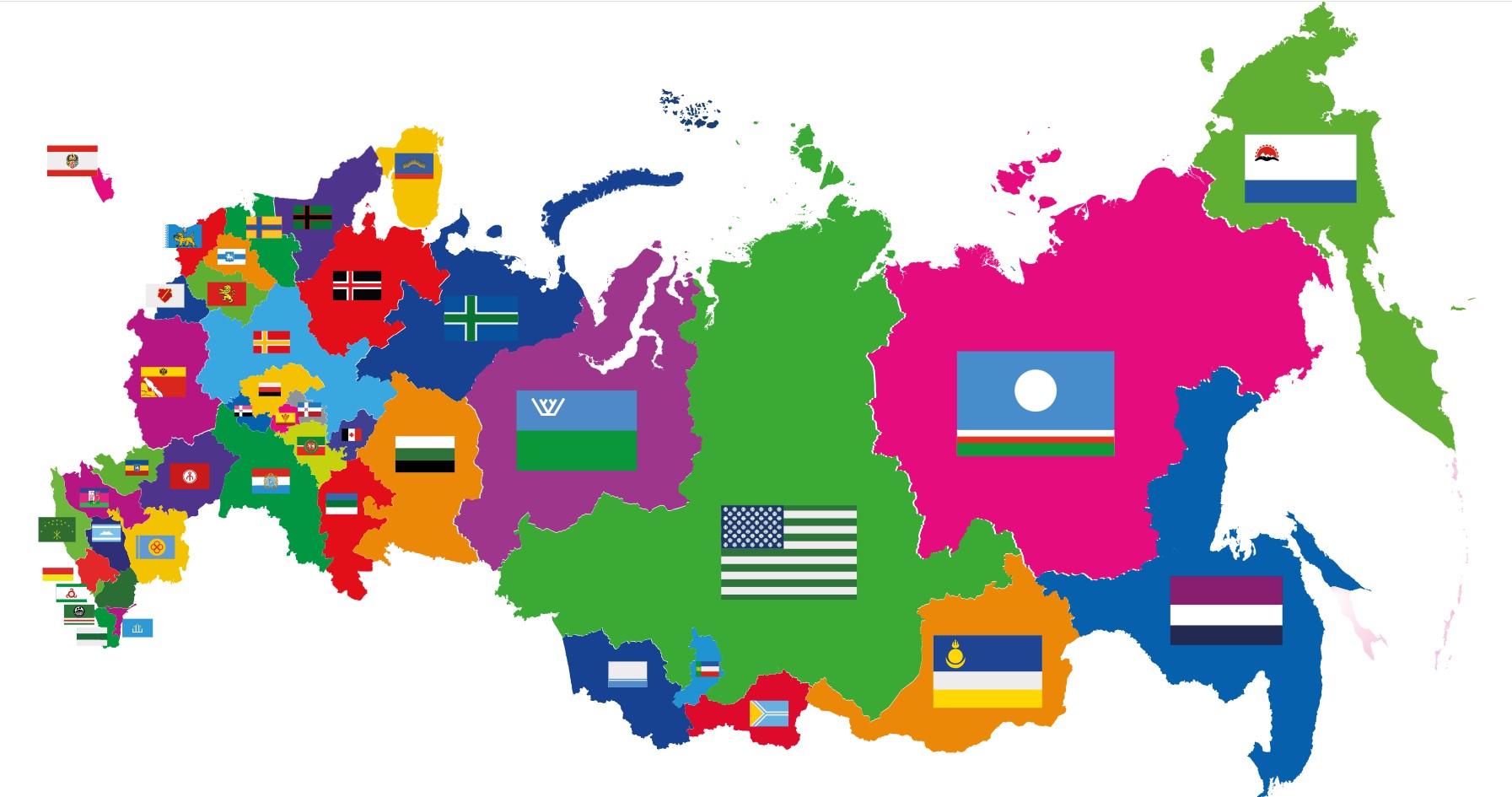
Non-Governmental Analytical Center “Ukrainian Studies of Strategic Disquisitions” continues the long-term project of Monitoring regional processes in the RF
The goal of the research is the fixation and determination of the dynamics of conflict-generating and disintegration factors that will contribute to the deconstruction of the Russian Federation and its disappearance as a geopolitical reality.
The object of monitoring is the information field of the Russian Federation; the most popular news for the quarter in various regions of Russia are analyzed, which will give a more or less clear idea of the internal processes occurring on the territory of the aggressor state and will allow for the monitoring of conflict-generating regional processes.
Monitoring of regional processes in the RF: autumn 2025
In the autumn period, tendencies aimed at the development of crisis elements recorded in previous monitoring periods are observed in Russian regions – oppression of the opposition, aggressive actions of the authorities against their opponents and the suppression of any alternative, problems in the housing and utilities sector, and in the economy in general. During this period, a fuel crisis was added, and the intensity of Ukrainian UAV strikes deep into the regions of the RF increased.
CENTRAL-WESTERN REGION
Moskovshchyna (Moscow Region)
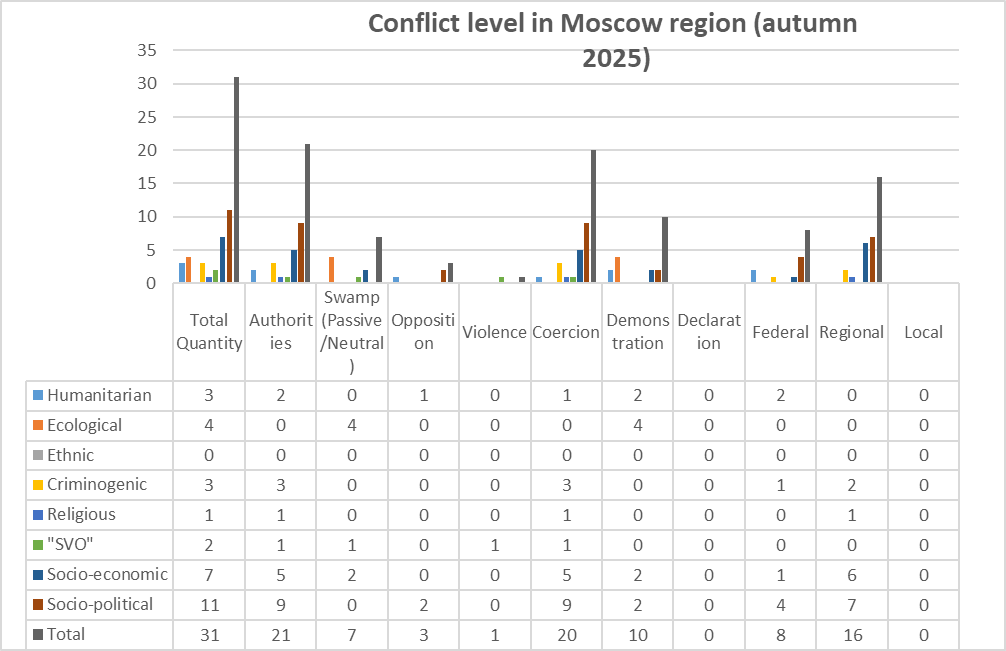
In the autumn of 2025, a general increase in tension in the humanitarian, cultural, and socio-political spheres is observed in the Moscow region. The strengthening of state ideologization under the guise of “traditional values” leads to conflicts in educational institutions and repressions against the cultural environment. The situation surrounding the detention of the band Stoptime became a symbol of point cultural resistance, which, however, remains local and does not grow into mass protest.
Ecological confrontations in the region have a spontaneous character and are related to the preservation of green zones. Although the actions do not scale up, the number of detentions of activists is growing, which may stimulate further online mobilization. Ethnic conflicts are not recorded in the open space, but a high risk of their exacerbation persists against the backdrop of resource problems and the activity of ultra-right groups.
The criminogenic situation is complicated by the growth of crimes associated with “veterans of the ‘SVO'”, as well as an increase in the number of fraudulent schemes surrounding state programs for “support” of the military. The fuel crisis in the autumn caused dissatisfaction among the population, although mostly in the online space; a repeated exacerbation of energy problems is possible by winter.
Politically, the region demonstrates the highest level of activity: the Kremlin continues to systematically eliminate any forms of opposition — from “Yabloko” to small parties. The recognition of FBK (Anti-Corruption Foundation) as a “terrorist organization” and the strengthening of pressure on “foreign agents” form an atmosphere of fear and paralyze organized protest.
Bryansk Region (Bryanshchyna)
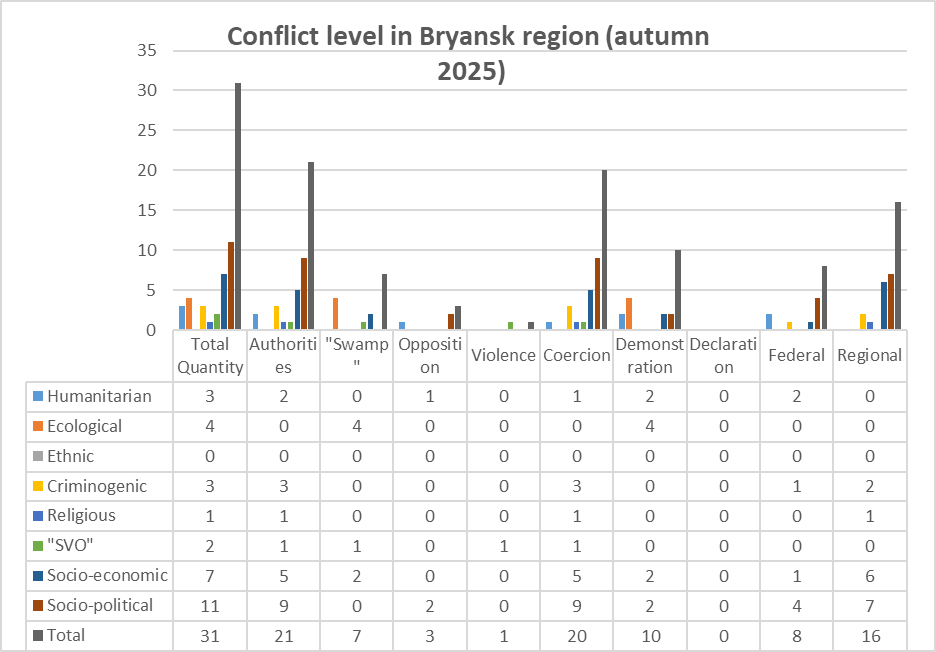
The autumn period in the Bryansk region demonstrated a combination of social tension, absurd political initiatives, and a deterioration of the economic situation. The symbolic start of the season was the adoption of a regional law on “inducement to abortion,” which provides for fines for citizens and legal entities. Even in the Russian information space, the initiative caused a wave of criticism and mockery, certifying the gap between the authorities and public sentiments.
In parallel, the fuel crisis intensified: from October 1, fuel quotas were introduced (15–17 liters per person), and gasoline prices rose by 20% in two months. Further accelerated price increases are expected — a trend common to the Bryansk, Kursk, and Belgorod regions. Economic instability is also manifested in a sharp increase in food prices (vegetables +15–20%, dairy and meat products +15–25%), and inflation in the region exceeded the federal indicator (8.49% versus 7.71%).
The socio-political space is filled with absurd conservative initiatives — in particular, a proposal to ban Halloween as a “satanic holiday.” This causes a mixed reaction ranging from laughter to indignation. Against the backdrop of a budget deficit, the authorities introduced mass police checkpoints for total fining of drivers, which increases dissatisfaction.
The situation is complemented by alarming social markers: the Bryansk region ranks third in the RF in the number of cancer patients, and the region suffers from a labor shortage. The combination of these factors forms zonal prerequisites for the growth of protest potential in the conditions of a border region.
Kursk Region (Kurshchyna)
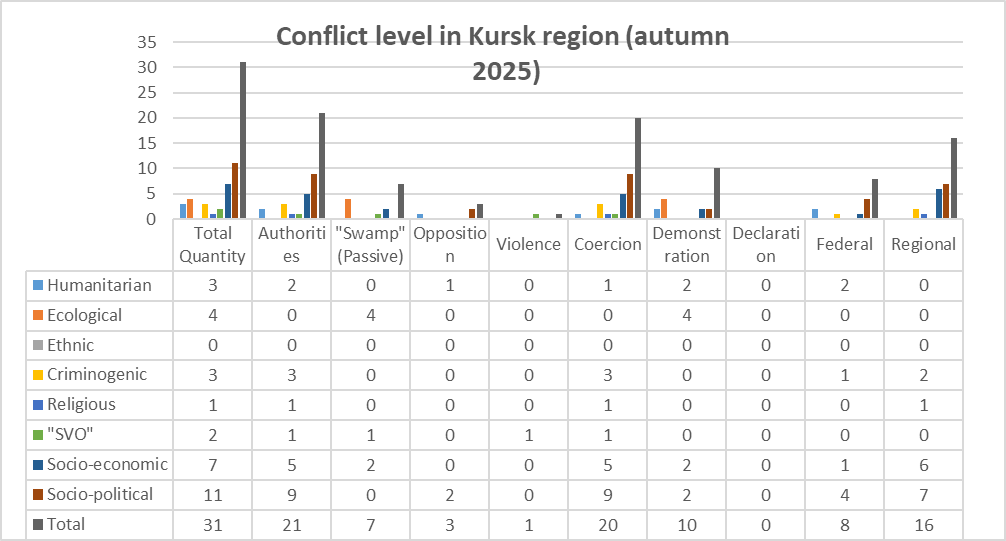
In September, suspicions began regarding the former Kursk governor Alexei Smirnov receiving an especially large bribe. The investigation believes that together with other officials, he stole 1 billion rubles intended for the construction of “dragon’s teeth.” At the same time, a case emerged involving the former advisor to the governor of the Kursk region, Roman Alekhin, who detailed the kickback scheme in the procurement of medicines for the front.
Also in September, the Humanitarian Project “Fellow Citizens” closed due to financial problems and a decline in interest in their work. The “Fellow Citizens” project appeared in August 2024 against the backdrop of the invasion of the Armed Forces of Ukraine (AFU) into the Kursk region.
In the Kursk region, a former university lecturer was sentenced to three years in a colony for a comment on social networks regarding the entry of the AFU into Sudzha.
On October 1, Mayor Alexander Khinshtein appealed to the FAS (Federal Antimonopoly Service) to control gasoline prices in the Kursk region. There are queues at gas stations in the region. Following the example of the initiative of the head of annexed Crimea, Sergey Aksyonov, who reduced the limit on issuing gasoline into one pair of hands from 30 to 20 liters.
On October 14, the head of the Kursk region, Alexander Khinshtein, stated that the budget situation is so difficult that it is planned to cut 5.3% from the executive apparatus bodies, specifically 1400 officials, which saved over 500 million rubles. Media report that a mass outflow of teachers is taking place from the Kursk region. An acute problem of personnel shortage has arisen.
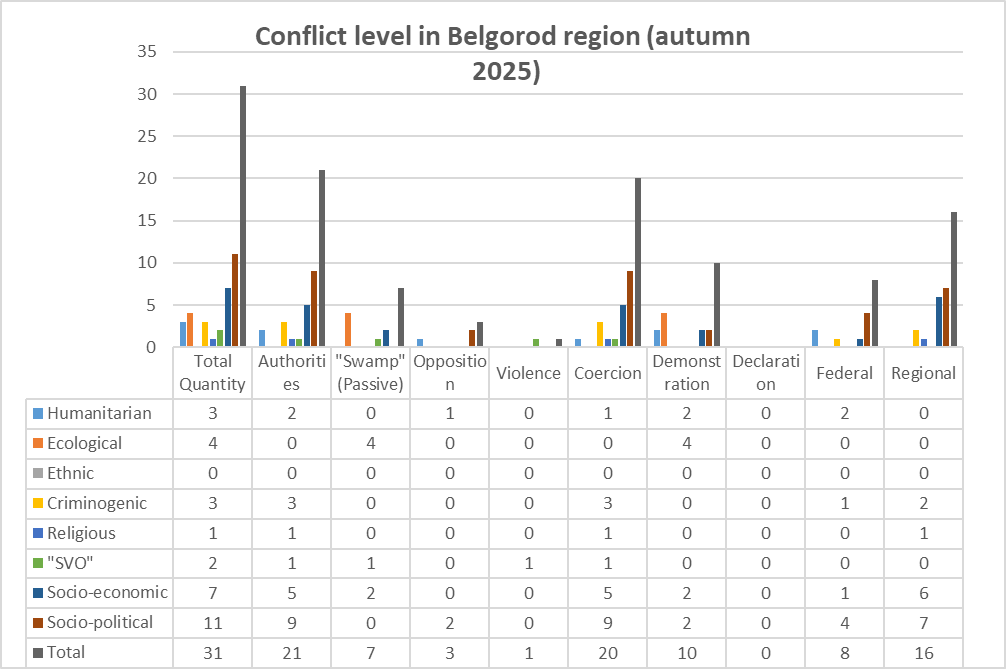
Belgorod Region (Belhorodshchyna)
The demographic crisis has not bypassed the Belgorod region either, where schools may start preparing students for weddings; they want to introduce a lesson “Preparation for marriage and family life” for high school students at the initiative of the ROC (Russian Orthodox Church).
At the end of October, the head of the Belgorod region, Vyacheslav Gladkov, warned residents of the region about an attack on the Belgorod reservoir, suggesting that residents evacuate. On the same day, the dam was hit by a drone.
In mid-October, Governor Vyacheslav Gladkov published a list of Telegram channels that create a “destabilization of the situation in the region.”
The situation with traffic accidents and power outages in the region is so deplorable that it is planned to distribute reflective armbands to people.
At the beginning of November in Belgorod, a serviceman, Alexei Kostrykin, escaped from custody; he had killed a man and raped his wife. Sugar prices rose by 20% in November, from 68 to 81 rubles. The reasons serve as a crop failure (-25% of the harvest) and logistics problems. Shipments of sugar beet in the Belgorod region fell by 96% (the indicator for Russia is 50%).
At the end of November, the Mayor of Belgorod, Valentin Demidov, in his Telegram channel, called on residents of the region to participate in voting and reported on the “fulfillment of civic duty,” despite the drone attack.
CAUCASUS
Dagestan
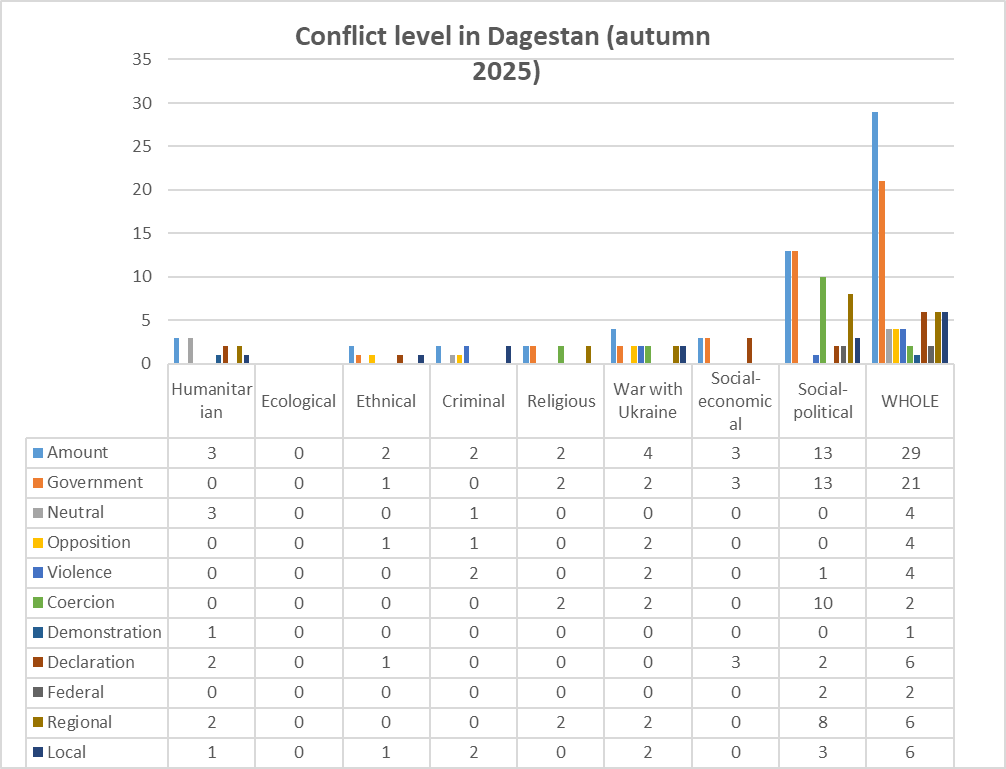
Dagestan experienced a series of resonant events concerning both the growing conflicts between society and the authorities, and Moscow’s repressions against the Republic’s elites. Noticeable growth of tension in October and November. In September, a notable event was the arrests of four residents of Buynaksk who allegedly planned to blow up the local Ministry of Internal Affairs department. Local elections on September 12 were accompanied by an infrastructure crisis – a water supply accident in Izberbash (60 thousand population), Buynaksk, and a dozen villages.
In October, the loudest event was the murder in Turkey of a political emigrant and oppositionist, the author of the Telegram channel “Morning Dagestan” (“Utro Dagestan”). He was likely killed by Russian special services. Cases against Dagestani businessmen and former government officials of the Republic, primarily the Magomedov clan, are also ongoing. A noticeable increase in repressions for involvement in “terrorism” and conflicts in the cultural field between the “Russian Community” (“Russkaya Obshchina”), which speaks with Islamophobic slogans, and the residents of the Republic. In socio-economic terms, a noticeable increase in fuel prices, particularly gasoline, across the entire North Caucasus.
In November, repressions are growing; religious figure Ahmad Batlukhsky was arrested. Regional politicians are being persecuted on corruption charges, in particular, ex-deputy of the State Duma from Dagestan Magomed Gadzhiyev and deputy of the People’s Assembly of Dagestan Ili Aliyev. Publicity from Ukrainian drone attacks is growing. On November 30, an attack by a man with a knife on police officers occurred; he died.
North-West Caucasus
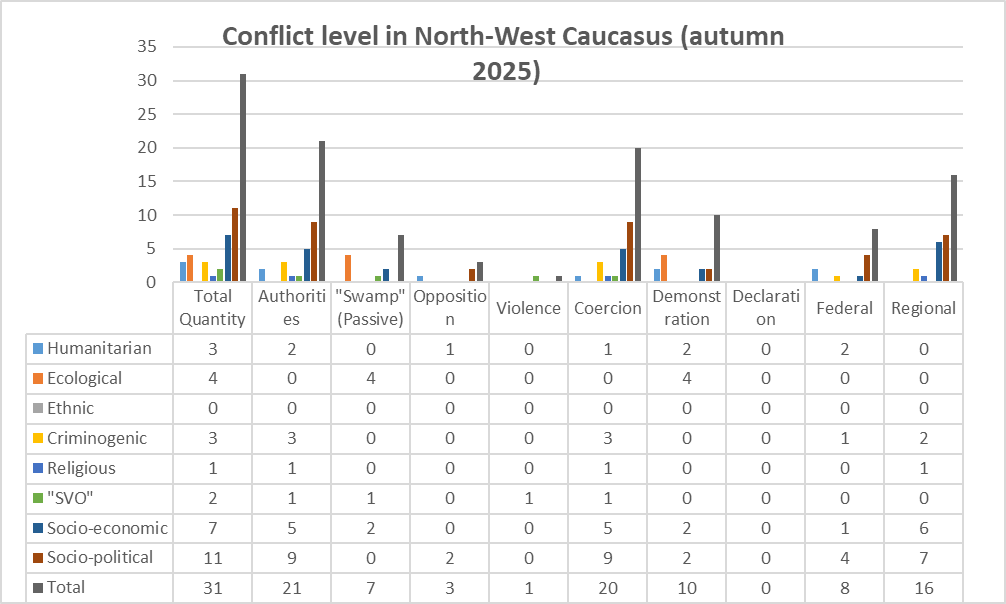
Autumn 2025 demonstrates further degradation of the security and socio-economic environment in the North Caucasus and adjacent regions. A significant part of the events forms not only the regional but also the federal agenda, as the scale of repressions and crises goes beyond the limits of individual subjects.
In Chechnya, the federal “five-hundred [ruble note]” turned into a political spectacle by Kadyrov with total mobilization of the population to vote for “Grozny City” on the new banknote. This emphasizes the privileged position of the republic and demonstrative loyalty to the center, which Moscow essentially buys with resources.
In Kabardino-Balkaria, FSB “death squads” remain a systemic problem: kidnapping and torture of locals have become the norm. The story of Kazbek Yemkuzhev is an indicative example of institutionalized terror, where even a confirmed video of kidnapping creates no legal consequences for the security forces.
The fuel crisis engulfed Kuban and Stavropol, exposing deep distrust of the authorities. The population registers a fuel deficit and price jumps, while regional and federal authorities deny the problem, creating a parallel information reality. This generates a demand for local protests — from online complaints to single-person pickets.
The situation is complicated by the consequences of the war: infrastructure collapse is growing on the Black Sea coast, especially water shortage. Novorossiysk has effectively turned into an ecological crisis zone. Against this background, the effectiveness of various psy-ops (IPSO), which use regional problems — from water deficit to hacking of religious institution websites — is growing.
CENTRAL-EASTERN REGION
Chuvashia
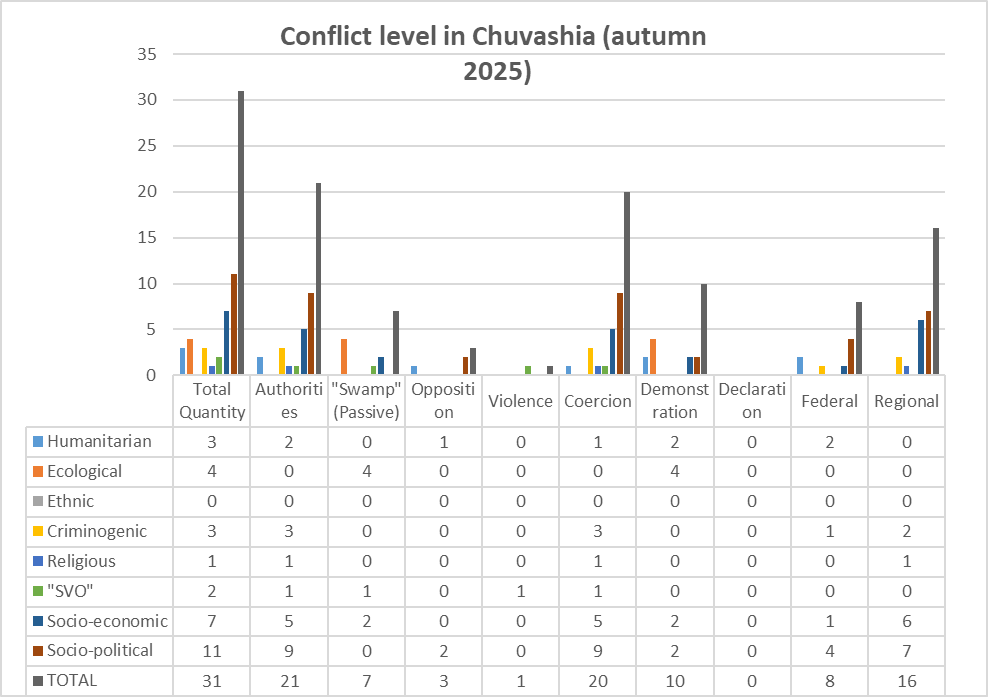
In autumn, there were several main problems in the region:
Elections. But this time, no provocations, no protests. The impression is that the local population has gotten used to the arbitrariness of the local authorities, and therefore does not even try to resist.
Attack of Ukrainian UAVs on factories. In fact, dissatisfaction was caused not by the fact of the attack itself, but by the fact that the local authorities did not inform about it even during the attacks, and also due to the disconnection of the internet and communications.
Regarding humanitarian problems, everything is stable in Chuvashia: lack of water supply, rising prices for utility services, and complete inaction of the authorities. Also interesting was the situation that occurred after the zoo-protests, where residents of Chuvashia demanded the construction of a shelter for homeless dogs. Initially, the new mayor of Cheboksary – Trofimov met with people and even promised to build new animal shelters, but later froze construction. The most protest moods are currently preserved specifically among zoo-defenders, and there can be two variants of events here. Either a shelter for animals will still be built in Cheboksary so that citizens can turn a blind eye to other problems in the region, or conversely, the shelter will not be built and the justification for this will be more important problems, in particular, the security situation.
Tatarstan
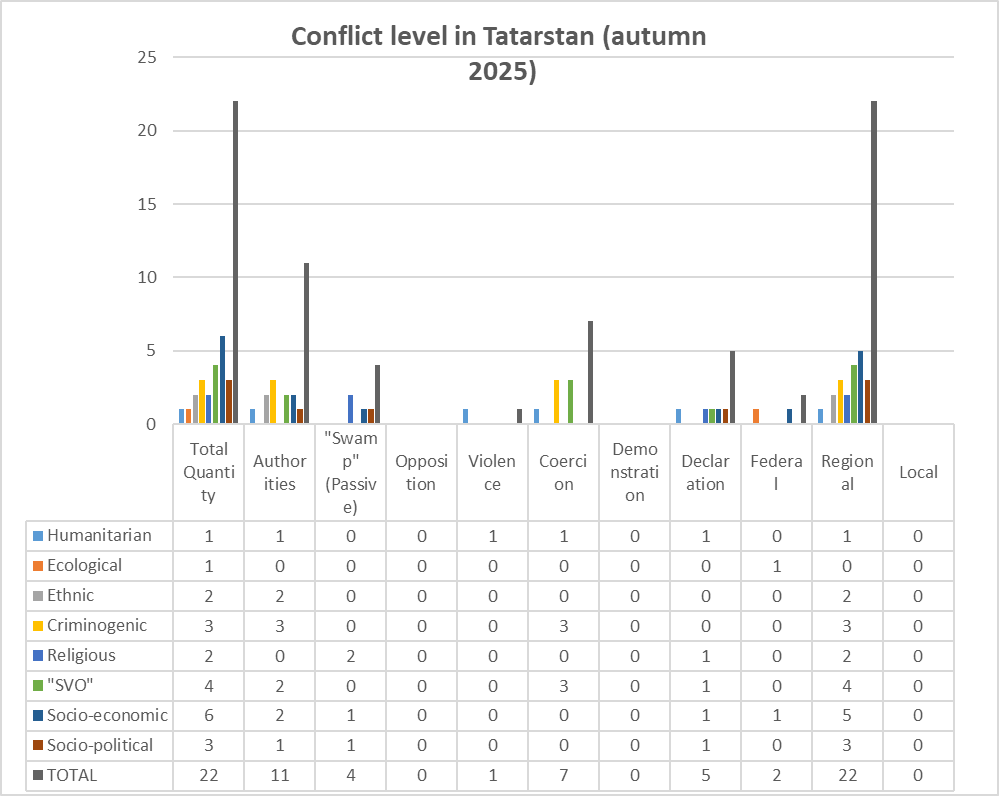
Autumn events in Tatarstan demonstrate a complex crisis in which economic, political, and security factors mutually reinforce each other. Sanctions by Japan and the EU against key enterprises (“Alabuga”, “KAMAZ”, “Sollers-Alabuga”, etc.) sharply exacerbated the republic’s dependence on the military-industrial complex and accelerated the decline of the regional economy: business losses grew to 72 billion rubles, and the large contractor PSO “Kazan” found itself on the verge of bankruptcy. A fire at a battery warehouse in “Alabuga” and interruptions with fuel after strikes on oil refineries demonstrate the vulnerability of rear regions and strengthen the mobilization of reservists for infrastructure protection.
The socio-political situation is worsening against the backdrop of increased repressions and the curtailment of national autonomy. Criminal cases against Tatar activists, the arrest of a Muslim blogger, and the forced entry of the Union of Writers of Tatarstan into the all-Russian structure signify the dismantling of cultural sovereignty. In parallel, right-wing radical groups are distributing anti-Islamic leaflets, provoking tension between communities.
The war has significant demographic consequences: the region ranks second in the RF for the number of dead military personnel, which strengthens hidden dissatisfaction with mobilization policy. The combination of sanctions pressure, ethno-political conflicts, and strikes on infrastructure makes Tatarstan one of the most vulnerable regions, where the potential for protests is growing, although currently held back by the security apparatus.
Orenburg Region
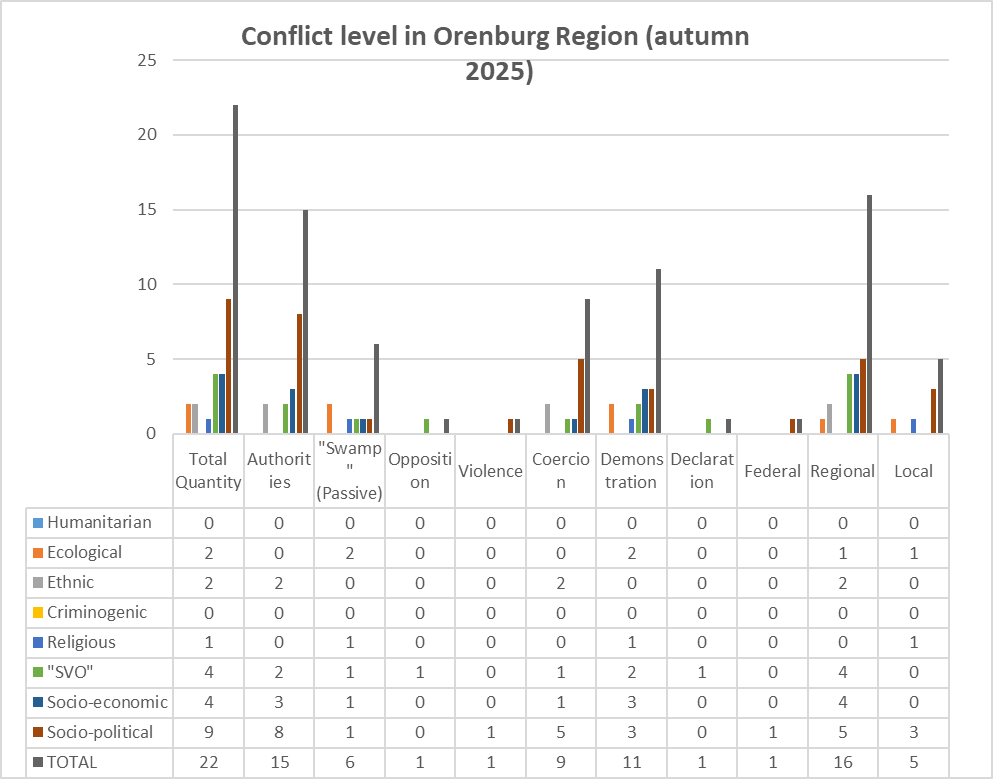
In the region, the impact of the war is increasingly shaking the local social and political situation. At the training ground in the city of Yasny, a massive explosion occurred on November 29, 2025, due to the failed launch of a “Voevoda” missile, which shocked locals and reached news abroad. After numerous UAV strikes on oil, gas, and chemical processing enterprises in the region, gas prices rose sharply and gasoline sales stopped at certain gas station chains during the autumn of 2025. Acting Governor Sontsev increased pressure on public events, putting forward demands regarding the proximity of bomb shelters and the installation of signs to them, and sought ways for new extractions at the oil and gas forum in Orenburg on September 3, 2025. One such way may be the start of exploitation of the Orikhiv oil field.
On September 14, 2025, Sontsev controversially won the governor elections of the region with 83.85%, after which he tightened the screws. For working for the AFU and SBU (Security Service of Ukraine), one citizen of Ukraine and one of the RF were detained in the region. Also under pressure were the editor of one of the Orenburg newspapers for violating the law on foreign agents and a former candidate for mayor of Orenburg for bribery. In Orenburg and the region during the autumn of 2025, people were stifled with restrictions on buying energy drinks and using scooters. The head of the Investigative Committee of the RF pressured local authorities over stupid pretexts throughout the autumn of 2025, as well as during past periods: traffic accidents without victims and quarrels in kindergarten. Deputy Minister of Defense Goremykin also visited the region for demonstrative support of veterans with Sontsev. After the elections, Sontsev reshuffled the government, leaving in it a vice-governor from 2013 who faithfully drags the region’s population into the yoke for the RF.
Against the background of the above, the protest activity of the population has been low so far. The only splash was a threat of a terrorist attack and the taking hostage of a local official due to the latter’s inefficiency by a resident of Novotroitsk on November 11, 2025. The desperado was detained by OMON.
Bashkortostan
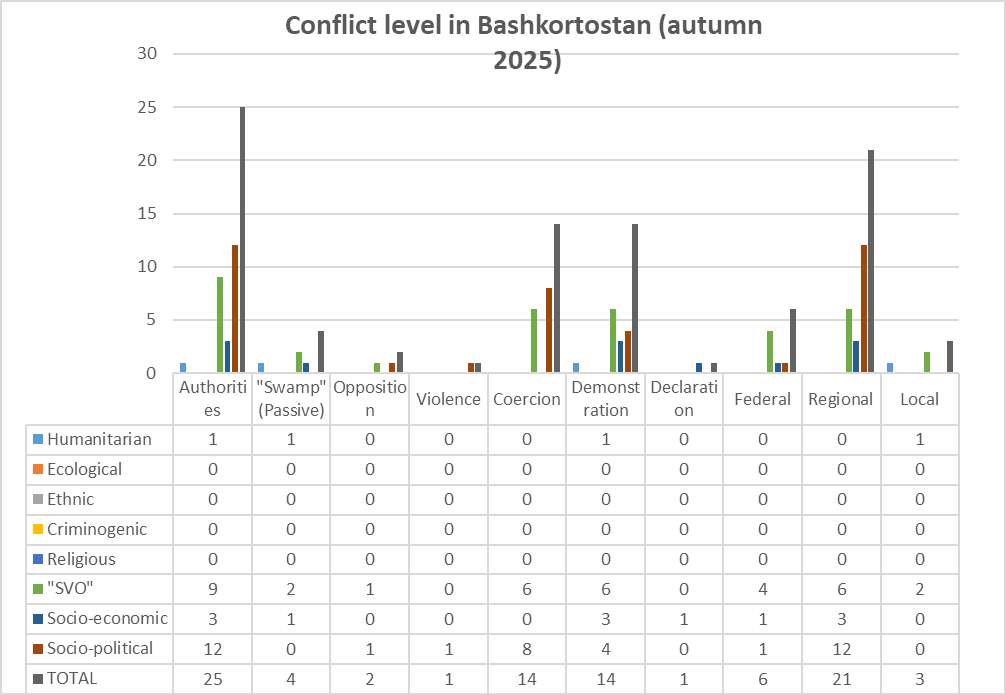
A political and economic crisis is growing in the republic; the war became a key factor in the autumn of 2025. Enterprises and oil refineries of the region were objects of UAV attacks 6 times. A powerful “pop” [explosion] sounded at the ammunition plant in Sterlitamak. The authorities of Bashkortostan tried to hush this up and reacted post-factum, banning the distribution of photos and videos of UAVs, electronic warfare, and air defense, and urgently recruiting reservists to guard critical objects. UAV strikes affect the economy with lightning speed, causing record gasoline prices in Bashkortostan in October. At the same time, real incentives for the participation of residents of Bashkortostan in the war are at zero for the regional authorities: payments for the first contract, reduced from July 5 to 1 million rubles, were reduced to 400 thousand rubles from November 1; only the authorities of one district introduced local compensation. The Republic has a record budget deficit planned for 3 years. The Head and Prime Minister of Bashkortostan are holding emergency meetings with the Central Bank of the RF regarding the economic collapse of the Republic. Bashkortostan remains the first among the regions of the RF in official population losses in the war against Ukraine.
To prevent a social explosion in Bashkortostan on these grounds, the RF authorities turned on maximum repressions. They are judging even friends of the Head of Bashkortostan Khabirov – the director of “Bashspirt” Abrahimov and Vice Premier Marzaev. Not to mention repressions against real or potential opposition elements. Among them are 5 women for alleged participation in the RF-banned “Volya Party”, the collectives of the publications “Aspects Bashkortostan” and “Prufy”, administrators of a number of channels in Telegram, natives of Bashkortostan Sharafutdinov for cooperation with the GUR (Main Directorate of Intelligence) and another for agitation to help the armed forces of an “unfriendly state”, singer Arkhipov for songs about “rusorez” [cutting Russians], participant in actions against fossil mining Baibulatov, and oppositionist Gumranova-Lion sentenced in absentia in emigration.
Khabirov is incapable of any protest against the pressure of the center, except for the cautious defense of convicted friends. 35 years of the Declaration of State Sovereignty of Bashkortostan were celebrated modestly, and Khabirov did not even use the word “sovereignty” in his speech regarding the holiday. The closure of the patriotic park of the RF in Bashkortostan due to mass poisoning of children – Khabirov did not support that either.
Obviously, against the background of the abyss into which the center of the RF is throwing Bashkortostan, the potential for support in the region for leaders of a real uprising against this can only grow!
Chelyabinsk Region
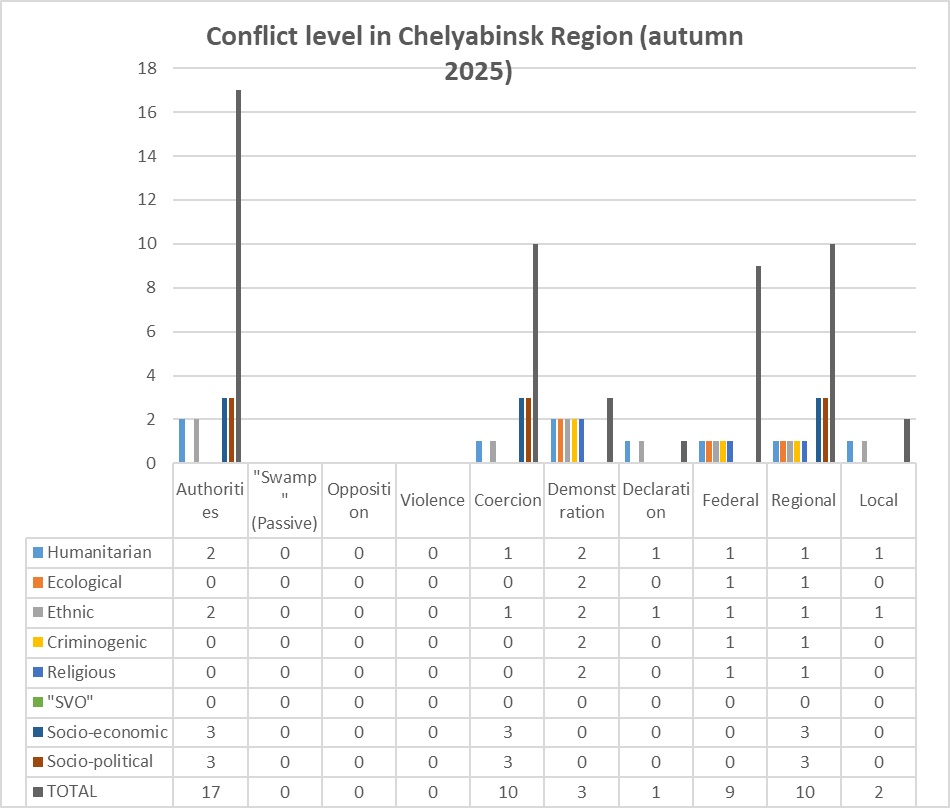
Unlike a number of neighbors, there is no ethnic tension in the region due to the predominance of the Russian population. A large concentration of industry allows the region to stay afloat, even despite the high level of pollution, crime, corruption, and a shortage of lower-level medical personnel. Putin’s appointment of A. Teksler (former Deputy Minister of Energy) to the post of governor of the region testifies to the high attention of the center. During the tenure of the new head of the region, although not quickly, a whole series of anti-corruption proceedings against a number of former and current top officials (Yurevich, Dubrovsky, Nechaev) was set in motion, as well as a number of measures for general stabilization in the region. Local authorities substantially support the “SVO” (both in the material-technical plane and in the form of fairly high “lift” payments, which create demand for military service among the population, although this hits the budget). The region was not without opposition (Navalny supporters and individuals), but the majority have been squeezed abroad (specifically, all the latest “foreign agents”). Only once was the region attacked by Ukrainian UAVs. Unlike central regions, the Chelyabinsk region is not in demand among labor migrants; their presence is insignificant. Overall, the region can be called a solid middling (in 20th place for quality of life in the RF). Protest potential is currently low.
FAR EAST
Kamchatka
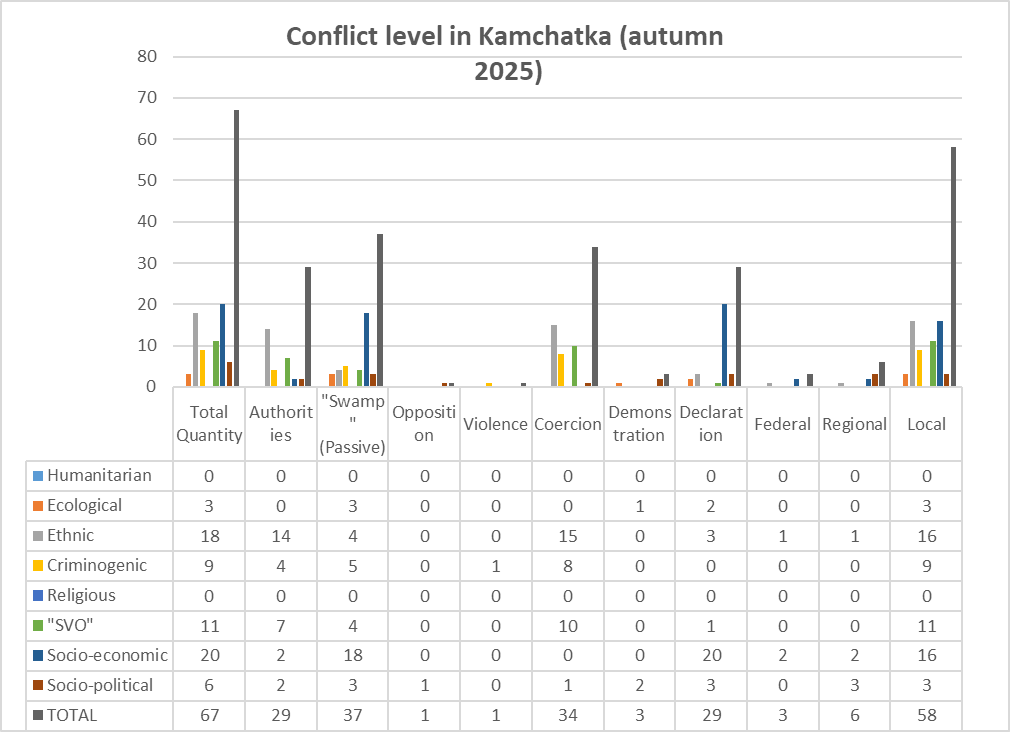
In the regions of the Okhotsk Sea in the autumn of 2025, a complex destabilization is observed in most key spheres. The humanitarian situation is generally controlled, but a shortage of personnel in educational institutions is recorded. The situation with ecology is much worse: a catastrophe was recorded in Kamchatka in the Avacha Bay, which led to the mass death of marine fauna and a shortage of fish products. On Sakhalin, local protests arose against the operation of an asphalt plant. Ethnic risks are growing: the authorities are strengthening the fight against migrants, including the deprivation of citizenship in Kamchatka, for the first time in the RF. On Sakhalin, physical attacks on migrant traders took place with the tacit participation of the administration. The criminogenic background is characterized by loud show cases regarding “extremism” and “terrorism,” including the public case of teacher Vasilina Vershinina.
The military factor is manifested in high rates of desertion on Sakhalin, an increase in crimes among the military, and cases of illegal circulation of explosives.
The socio-economic situation is worsening due to a fuel shortage, interruptions in food supply, and fear of a three-day internet shutdown, which caused panic among the population. Seismic activity accelerates the outflow of the population to the mainland.
The political sphere is also unstable: in Kamchatka, elections were accompanied by a record number of spoiled ballots, the KPRF (Communist Party) accuses the authorities of falsifications, and youth protest against control over the internet. On Sakhalin, a pro-government rally against Japan was organized, which caused a diplomatic response from Tokyo.
Overall, the region demonstrates an accumulation of conflict factors, however, the active protest potential of the population remains low, mostly limited to online reactions.
CONCLUSIONS
The increase in the intensity of strikes by Ukrainian UAVs deep into the territory of the RF, especially on fuel infrastructure objects, led to the war “moving from the TV to the pockets and often homes” of the Russians themselves.
The deterioration of the economic situation in Russia, caused, in particular, by damage to the infrastructure of its oil industry, leads to a strengthening of protest moods, which destabilizes the situation especially in depressed regions already now. In response, the authorities are strengthening the flywheel of repressions, which allows keeping the state of affairs under control for now.
A separate aspect of the deterioration of the economic position of the aggressive federation is the difficulty of payments to so-called “SVO participants,” that is, occupiers who go for money to kill Ukrainians on our own land. In the long term, this may become a factor in both the difficulty of recruiting new mercenaries and problems with those who have already returned from the predatory war and encountered the realities of life in their country. Also relevant in the regions of Russia remain problems with housing and communal services (ZhKH), ecology, and human rights. Each of these factors has the potential for development, and under favorable circumstances, may flare up in the form of a civil conflict or spontaneous uprising.
Authors: Yuriy Oliynyk, Ivan Yaniuk, Mykola Volhov, Oleksiy Tkachenko, Andrii Kovaliov, Andrii Mykhailichenko, Armais Ohanyan, Yulia Dolia, Iryna Yevdochenko, Ivan Hatsenko
Translator: Oleksandr Chupak
Leave a Reply