
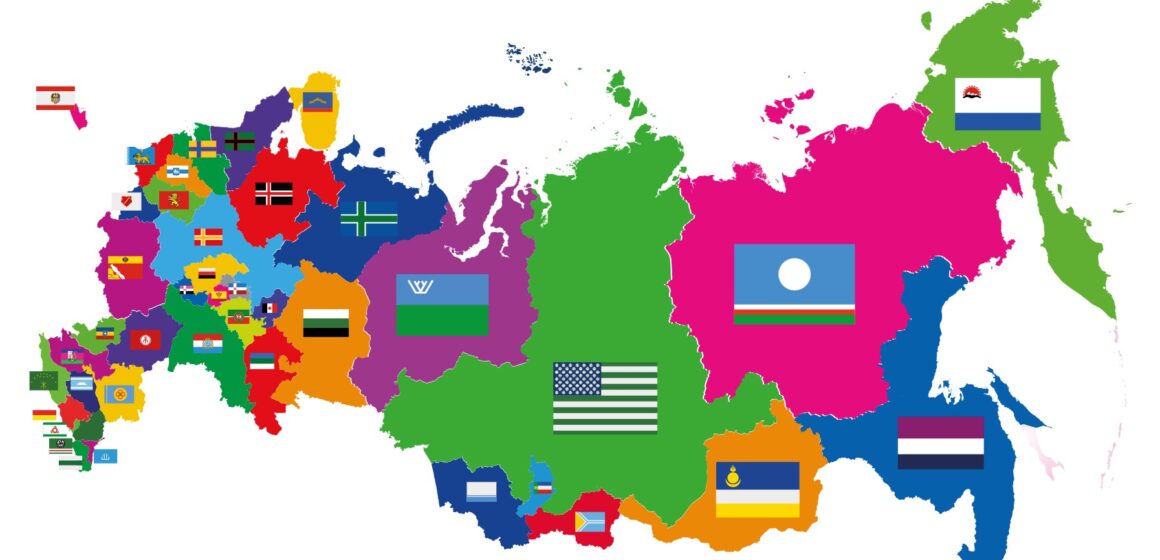
The non-governmental analytical center “Ukrainian Studies of Strategic Disquisitions” continues its long-term project of Monitoring Regional Processes in the Russian Federation.
The aim of the study is to record and identify the dynamics of conflict-generating and disintegration factors that may contribute to the deconstruction of the Russian Federation and its disappearance as a geopolitical reality.
The object of monitoring is the information space of the Russian Federation. The most popular news from various regions of Russia over the quarter is analyzed, which provides a more or less clear picture of the internal processes taking place within the territory of the aggressor state and allows for monitoring of conflict-generating regional developments.
Monitoring of regional processes in the Russian Federation: Winter 2025–2026
During the winter period, various regions of Russia continue to face the same problems—outdated and poor-quality infrastructure, a weak social sector, and a corrupt and ineffective власть imperial in nature. At the same time, the problems of strikes by Ukrainian UAVs and missiles are increasingly being added.
CENTRAL-WESTERN REGION
Moscow Region
The winter period of 2025–2026 in the Moscow region is characterized by a combination of growing social discontent, increased digital control, and a worsening security situation. The main problems are concentrated in the humanitarian sphere, the information space, and коммунal infrastructure.
In the information sphere, significant dissatisfaction was caused by the forced introduction of the state messenger MAX in public sector institutions. At the same time, restrictions on alternative platforms, particularly Telegram, triggered a sharp reaction from users. The situation worsened after technical failures in MAX, which could not handle the load during the blocking of other services. The main centers of public discontent were Moscow, Kaluga, and Vladimir.
The infrastructure situation deteriorated due to unfavorable weather conditions and security incidents. In January, a number of settlements in the Moscow, Kaluga, and Vladimir regions experienced prolonged interruptions in electricity and heating supply. Against the backdrop of severe frosts, this led to a sharp increase in criticism of local authorities, although open protests remained sporadic.
The security factor in the region is also becoming increasingly significant. In addition to drone attacks, car explosions linked to representatives of security structures were recorded in the capital. Such incidents undermine the sense of security even among pro-government groups and stimulate the search for “internal enemies” in political discourse.
The socio-economic situation is worsening due to rising inflation and increased utility tariffs, which in some regions exceeded 10–20%. At the same time, the authorities are tightening control over the political space: security forces continue suppressing opposition activity, including during commemorative events related to deceased opposition figures. The combination of these factors creates a tense but controlled socio-political environment.
Conflict level in Moscow region (winter 2025-2026)
Bryansk Region
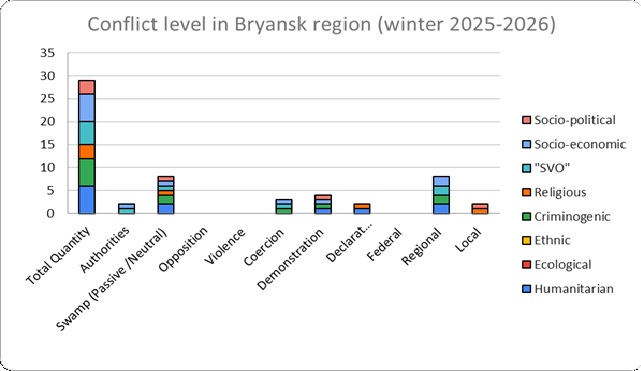
The situation in the Bryansk region is characterized by a combination of security tension, socio-economic pressure on the population, and increased administrative control. The region, which directly borders Ukraine, is heavily influenced by the war, shaping a significant part of the local agenda.
Corruption remains a systemic problem. Over 11 months, prosecutors recorded 364 corruption-related crimes, with the total amount of bribes exceeding 34 million rubles. These figures indicate the deep integration of corrupt practices into the activities of regional authorities and administrative structures.
The socio-economic situation for the population is gradually deteriorating. At the beginning of 2026, there was a simultaneous increase in tariffs and payments: public transport fares rose, travel passes became more expensive, waste collection fees increased, and for residents without meters, the water payment standard was doubled. An additional factor of discontent was the rise in car prices due to an increased recycling fee. Against this backdrop, local social conflicts are emerging, including protests by taxi drivers against aggregator pricing policies.
Authorities are strengthening regulatory and informational control: restrictions on publishing materials about military facilities have been expanded, and new administrative limitations have been introduced—from fines for decorating building facades to bans on fireworks. At the same time, moral and ideological initiatives are being observed, including proposals to restrict “non-traditional” names.
The security situation remains tense due to regular drone attacks and border-related risks. Despite official claims of stabilization, regional information sources report a high level of threats, making the Bryansk region one of the most unstable border regions of the Russian Federation.
Kursk Region
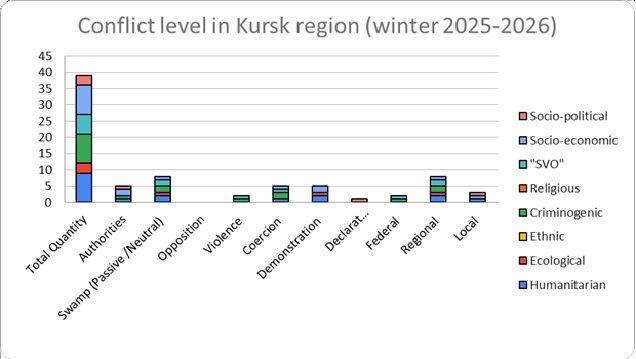
The situation in the Kursk region is characterized by a simultaneous escalation of security risks, infrastructure degradation, and growing social discontent. As a border region, it is directly affected by the war, which shapes a significant part of its political and social agenda.
Social tensions sharply increased after the authorities decided to cancel monthly payments of 65,000 rubles for displaced persons from border areas. This led to spontaneous protests by residents of the Sudzhansky district and video appeals to the Russian leadership demanding the acceleration of housing certificate distribution. The authorities responded with targeted detentions of active protest participants.
The winter of 2025–2026 exposed the critical condition of regional infrastructure. Accidents in heating networks left around 150 buildings without heating in Zheleznogorsk, as well as several educational institutions. Frequent water pipeline ruptures, the collapse of a water tower in Gorshechnoye, and a major sewage leak in Kursk caused environmental problems and disruptions in water supply. At the same time, power outages have been recorded: a strike on a substation left about 28,000 residents of border areas without electricity.
Against this backdrop, high-profile corruption scandals continue among the regional elite, involving the embezzlement of funds allocated for the construction of defensive structures and illegal construction permits. Internal conflicts among officials and symbolic controversies (including disputes over official vehicles) highlight a governance crisis.
The security situation in border areas remains critical: drone attacks, damaged infrastructure, and dangerous evacuation conditions create a constant threat to civilians. The combination of these factors forms a persistent potential for social destabilization in the region.
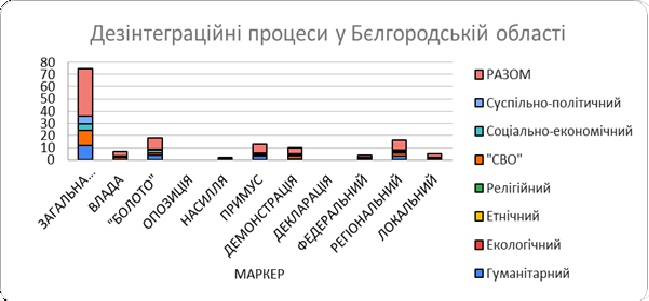
Belgorod Region
The Belgorod region during the winter period of 2025–2026 remains in a state of постоянной security and infrastructure crisis caused by its proximity to the combat zone. The region effectively operates as a border rear area, where the military factor determines most socio-economic processes.
The security situation remains unstable due to regular missile and drone attacks. One of the largest incidents occurred on January 9, when more than 550,000 residents were left without electricity and about 200,000 without water supply. In February, shelling left around 80,000 people in Belgorod without heating. The city periodically experiences de facto blackouts, forcing authorities to open temporary heating centers and consider evacuating vulnerable groups to other regions.
The infrastructure situation is rapidly deteriorating. Frequent accidents in heating networks, disruptions in water supply, and electricity outages are causing humanitarian difficulties: residents report having to melt snow for household needs, while hot water supply in student dormitories has been suspended. Amid power shortages, prices for generators have sharply increased.
Economic activity in the region is gradually declining. A telling signal was the decision of a major food producer to relocate its production facilities to another region, indicating a worsening investment climate due to security risks.
The social atmosphere is characterized by a mix of anxiety and gradual adaptation to wartime realities. Authorities attempt to sustain a mobilization narrative by opening memorials for victims of shelling and expanding military-judicial infrastructure, while simultaneously facing chronic problems in public utilities and regional governance.
CAUCASUS
Dagestan
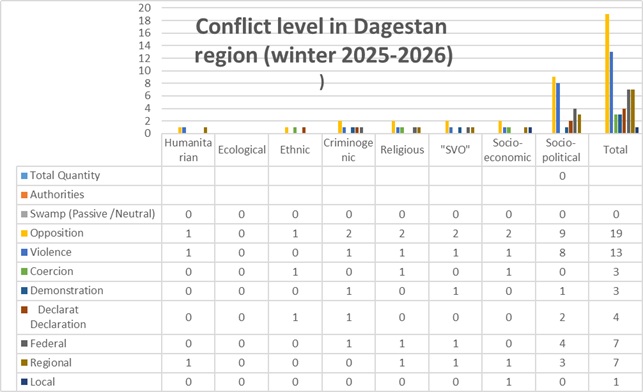
During the winter, conflicts in the socio-economic sphere in the region noticeably intensified, with particularly pronounced tensions in the socio-political domain.
Attacks on police officers have become increasingly frequent, and people are gradually refraining from openly expressing dissatisfaction with the authorities. A notable example is the case of a conscript beaten at a military unit in Voronezh, where his father raised the issue with local deputies—and they even supported him. This likely would not have happened if the beating had occurred in a local unit, but it took place in another region. The incident clearly illustrates the centrifugal tendencies present in the region.
Dissatisfaction is also growing due to infrastructure problems. A vivid example occurred in the city of Kaspiysk, where several streets remained without centralized water supply for nearly a week.
To prevent the development of local anti-government protests, the federal center is carrying out repressive measures against local elites, officially under the banner of fighting corruption. Several cases have been initiated against current and former high-ranking local officials.
Northwestern Caucasus
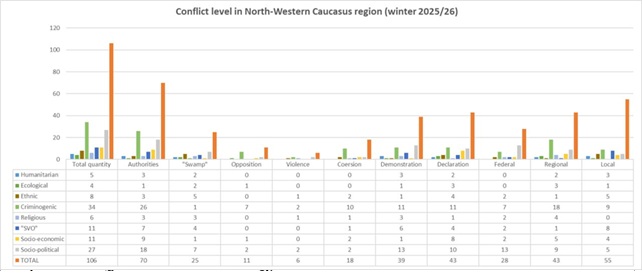
During the winter of 2025/26, monitoring of open-source reports (media, social networks, messengers, etc.) recorded 106 events containing conflict-generating features and exhibiting a deconstructive impact on the region.
The authorities were the initiators of most of the recorded conflicts. Government bodies specifically target activists, exerting pressure on local youth, civil society figures, and ordinary citizens who take even minimally active social positions. Citizens are arrested and sentenced to real prison terms even for the slightest hints of disobedience to the authorities. A notable example is the case of a teenage girl from Krasnodar, who, in a messenger chat she administered, called for violent actions.
At the same time, cases against organizations associated with early-century fighters for the freedom of Caucasian peoples, as well as cases against “extremists” with pro-Ukrainian positions, are becoming more frequent. These latter cases often proceed without disclosure of specific details, indicating that the authorities fear public attention.
It can be noted that in the Northwestern Caucasus there are currently two movements that view radical actions as an acceptable means of resisting Moscow’s occupation: the traditional Islamic movement and a new pro-Ukrainian movement, which has revived in the context of the “special military operation” (SVO).
The authorities are attempting to suppress all separatist manifestations, including against the organization “Malinoviy Klyn,” which seeks to achieve independence for Kuban from Moscow.
Separately, local residents strongly reject the pro-government “informant” messenger MAX. Locals clearly do not accept it, and its continued aggressive promotion could become a source of significant conflicts and ultimately lead to civil confrontation in the region.
CENTRAL-EASTERN REGION
Chuvashia
The winter period of 2025–2026 in Chuvashia revealed the accumulation of several systemic problems in the security, social, and infrastructure spheres. Some of the new challenges are a direct continuation of longstanding structural issues in the region—weak governance, infrastructure decay, and growing social discontent.
The security situation worsened due to incidents involving drones that damaged residential buildings. The main problem was not so much the scale of destruction but the inefficiency of repair efforts. Residents had to seek compensation through the courts, while repairs carried out were often formal or of poor quality. This indicates the local authorities’ aim to demonstrate a quick “reportable” resolution of incidents without actually addressing the underlying problems.
Another factor fueling dissatisfaction was internet and communication outages. Restrictions imposed under federal directives, allegedly for security reasons, provoked sharp reactions from the population, especially since state-controlled digital services continued to operate with minimal disruption.
Social tension is further aggravated by environmental issues and the so-called “optimization” of the healthcare system, leading to the closure or downsizing of hospitals in small settlements. As a result, residents are forced to travel long distances to larger cities for medical care. The situation is compounded by the extremely poor condition of road infrastructure, placing the region among the most problematic in the country.
Overall, the winter period showed rising local dissatisfaction, but the protest potential remains limited to adaptive behavior by the population. It is likely that with the end of winter and further deterioration of roads and utilities, social tension in the region may intensify.
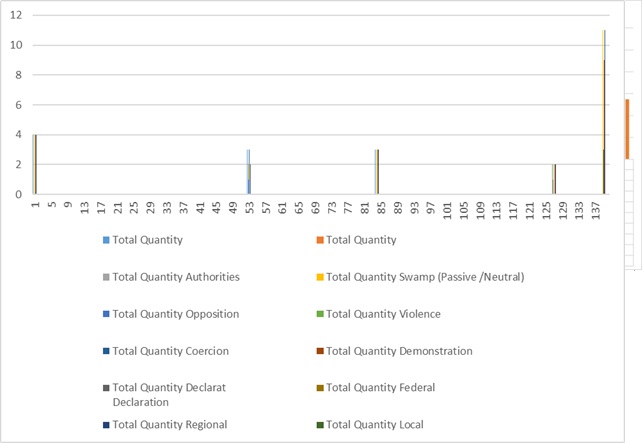
Conflict level in Chuvashia (winter 2025-2026)
Orenburg Region
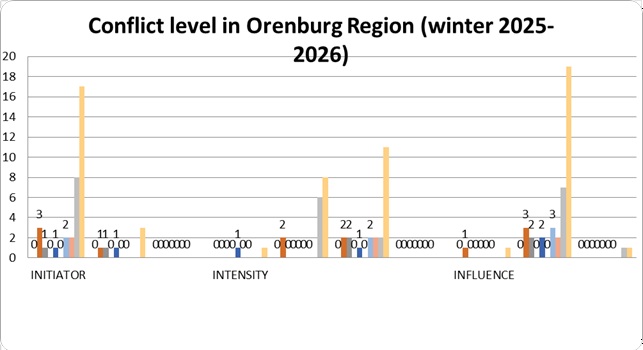
Orenburg Region is a fairly typical “middle-tier” administrative unit within the Russian Federation. The main employment sectors are industry—primarily ferrous metallurgy, oil extraction, and machinery manufacturing. During the war, the military has tried to compete for personnel by offering much higher pay, but in the second half of 2025, demand declined due to the deployment of local military units to the most difficult sections of the front. As a result, authorities were forced to make significant efforts to increase monetary incentives for signing contracts.
Beyond industry, the region is strategically valuable to the authorities due to its distance from active combat zones. However, critical infrastructure remains at risk because of the increasing range of Ukrainian drones and missiles (as repeatedly demonstrated in neighboring territories) and the potential redistribution of air defense resources to other regions.
Since the region lacks a significant active minority population or serious civil opposition (with many “foreign agents” being forced abroad), active social unrest is most likely only in the event of a critical shortage of funds for basic necessities.
Bashkortostan
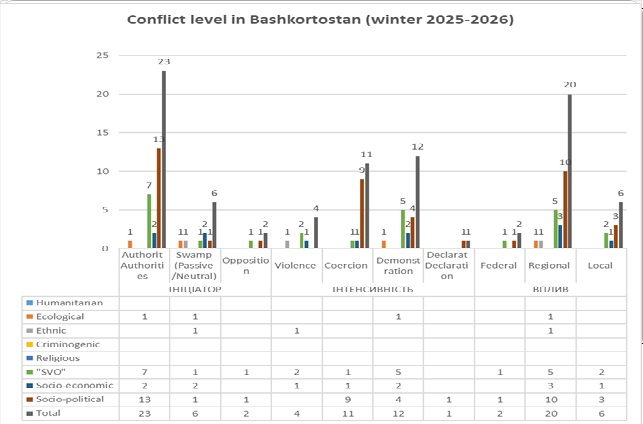
In Bashkortostan, under directives from Moscow, the head of the Republic, Radiy Khabirov, intermittently restored the 1 million ruble payment for the first contract with the Russian Armed Forces until February 28, 2026. This was done at the cost of nearly tripling the budget deficit of Bashkortostan. Other payments to military personnel were reduced both across the Republic and by local authorities, including in the capital, Ufa. Tariffs and prices are rising, and locals are widely criticizing official economic statistics as falsified. In his annual address to the State Assembly of Bashkortostan in 2026, Khabirov focused exclusively on promoting the war against Ukraine, barely mentioning the problems of the Republic’s residents.
To increase Bashkortostan’s role in the war, Khabirov signed a law requiring 1% of veterans to be employed in enterprises and encouraged nominating veterans for local government positions. Khabirov’s strategy appears aimed at demonstrating loyalty to Moscow as an active supplier of manpower for the war, ensuring his standing with the federal center. This occurs against the backdrop of the 2025 corruption arrest of the Minister of Culture of Bashkortostan, Shafikova, who had held the post since 2012. The consequences of Russia’s unleashed war, supported by officials like Khabirov, continue to return to Bashkortostan in the form of drone attacks.
Signs of destabilization in Bashkortostan include both organized and spontaneous citizen actions that escape government control. Organized actions include a victory by opponents of renaming a street in Ufa after the Bashkir-opposed politician Zhirinovsky, supported by national organizations. Chaotic and violent incidents include a stabbing of Indian students and a school shooting by teenagers in Ufa. Deserters from the Russian army also participate: two deserters killed local Bashkortostan farmers.
The Russian authorities in Bashkortostan are attempting to restore control through maximum repression. Even conscription is conducted as covert mobilization: in Neftekamsk, resident Danila Melnikov was forcibly taken from his apartment and made to sign a contract. Other punitive actions include: a 4-year prison sentence for an Ishimbay resident for urging enlistment in the 3rd assault brigade; arrests of four unnamed Bashkortostan residents suspected of terrorism, including two minors; forced treatment of Vadim Kilyadirov for allegedly planting a bomb at a military enlistment office and arson on orders from the “Freedom of Russia” Legion; activist Sharatfutdinov remained detained after the cancellation of his sentence, with the case sent for retrial; a resident of Meleuz sentenced to forced labor for funding the religious organization “Revival” from Ukraine; and fines imposed on activist Aslayev for anti-Russian Armed Forces comments on social media. Authorities also resumed attempts to block Telegram, including in Bashkortostan, while local authorities introduced criteria to assess songs for destructive or anti-patriotic content.
Additionally, the ecological situation is worsening, with violations of environmental regulations increasing fourfold compared to 2024.
Overall, the situation in Bashkortostan during the winter of 2025–2026 resembles patching holes in a collapsing ship with plasters—the repressive apparatus struggles to hold together amid economic problems and rising social discontent.
Udmurtia
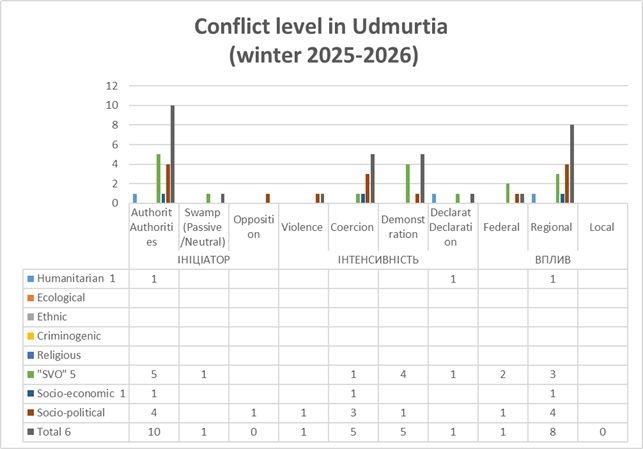
The Republic of Udmurtia has not experienced large losses or high levels of population involvement in the war against Ukraine compared to some neighboring regions, such as Tatarstan and Bashkortostan (approximately three times lower). Therefore, social tension over the consequences of participation in the war is relatively limited. However, another factor drives discontent: the concentration of fuel and defense industry enterprises in Udmurtia, notably Udmurtneft, the Kalashnikov Concern, and the plant in Votkinsk producing missiles, including intercontinental ballistic Iskander and Kinzhal systems.
On February 20, 2026, one of the plant’s workshops burned down in an attack, injuring 11 Russian personnel. The Ukrainian General Staff acknowledged the strike, reportedly using Flamingo missiles. Local residents panicked, and some criticized the Russian authorities on social media for the attack as a consequence of the war against Ukraine. Udmurt authorities denied that the strike involved missiles, claiming it was caused by drones. In reality, drones attacked the republic at least twice during the winter of 2025–2026. Authorities had previously claimed the situation was under control, yet on January 6, 2026, they had to close traffic in the Udmurt capital, Izhevsk, during one such incident.
The economic situation in Udmurtia is also worsening: tariffs in 2026 are rising faster than in most neighboring regions (similar only to Perm Krai). Officials attempt to offset economic losses through corruption, which became evident when one municipal official in Sarapul was detained for selling data from state registries. The Federal Antimonopoly Service found that the Udmurt military enlistment office granted illegal privileges to a funeral agency handling the burials of soldiers killed in the war against Ukraine. Against this backdrop, Head of Udmurtia, Alexander Brechalov, has made statements of questionable relevance to residents, such as urging people to watch the 32nd Winter Rural Sports Games in Krasnogirskoye rather than the Olympics.
Local dissent against involvement in the war manifests in violent actions. On February 24, 2026, a native of Mozhga detonated a DPS (traffic police) vehicle in Moscow, killing himself and a lieutenant, while injuring two other officers. Meanwhile, Udmurtia’s human rights commissioner, Viktor Kushko, has publicly engaged with dissatisfied residents. On February 17, 2026, he acknowledged multiple violations of the rights of Udmurt soldiers in 2025, including unauthorized leave, issues with medical discharge, and discrepancies between official Ministry of Defense records and actual soldier statuses.
The Russian authorities in Udmurtia continue to suppress anti-war opposition through repressive measures. A Mozhga resident was sentenced to 18 years in prison for allegedly filming a government building and its employees for Ukraine’s Military Intelligence. The Udmurt Bar Association revoked the license of Talantov, its former head, who had been sentenced in 2024 to seven years in prison for allegedly spreading war-related “fake news” and inciting hatred. Other residents were sent to pre-trial detention for Telegram comments, accused of calling for violence and terrorist acts against Putin, police officers, the FSB, and Russians in general, or for alleged incitement to violent acts against police personnel.
Tatarstan
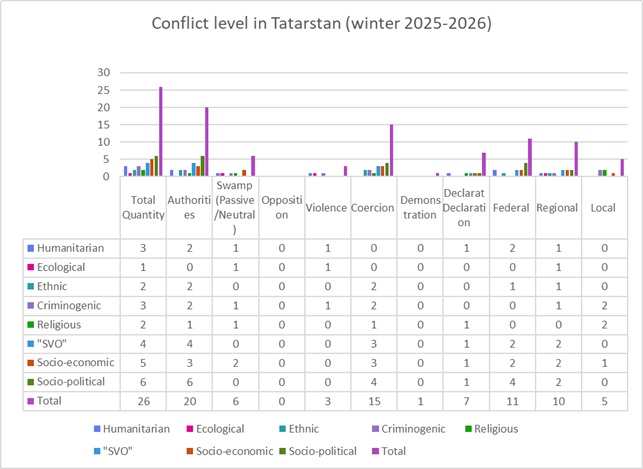
The winter period of 2025–2026 in the Republic of Tatarstan is characterized by the simultaneous intensification of digital control and deepening problems in municipal and transport infrastructure. Together, these factors indicate the systematic subordination of regional resources to the interests of federal military policy and centralized authority.
In the information sphere, measures to control digital communications have intensified. The promotion of the state messenger MAX is accompanied by administrative pressure, particularly on the student population, where mandatory QR-code identification is proposed for access to educational buildings. These steps are seen as preparation for restricting or blocking alternative communication platforms, primarily Telegram. An additional element of digital control is the expansion of regulatory authorities’ powers over internet governance and the implementation of systems to monitor students’ online activity.
At the same time, infrastructure conditions are deteriorating. At the local level, poor road surfaces and accidents in heating networks are causing disruptions to essential services in settlements during the winter period. Concurrently, authorities plan to raise utility tariffs in 2026 by 13–18%, creating additional financial burdens for residents.
The economic situation is also worsening due to rising transport costs and nationwide financial problems in the transport sector, which may lead to further increases in the prices of goods and services. Collectively, these factors create risks of growing social discontent, although at this stage it remains mostly latent due to strict administrative control and restrictions on the information space.
Chelyabinsk Region
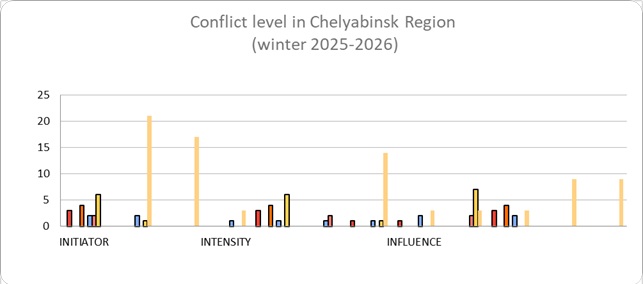
During the winter of 2025–2026, open-source data recorded 21 conflict-generating events in the Chelyabinsk region. The majority occurred in the socio-political sphere (7), followed by criminal, military, and humanitarian sectors (4 each), with the fewest in the socio-economic sphere (2).
The main initiator of these events is the authorities. Their activity manifests in arrests of individual Ukraine sympathizers (primarily for online positions, intelligence-related activities, or preparation of sabotage in the interests of the Armed Forces of Ukraine), as well as the initiation of multiple anti-corruption cases involving numerous top regional officials, including Vice-Governor Faleychik, former leadership of the Ministry of Transport (linked to former Governor Dubrovsky), the local head of Rospotrebnadzor, and participants in interregional corruption schemes within RZD.
Authorities also focus on maintaining the military apparatus: Governor Texler personally oversees the supply of essential industrial products to the front, ensures high-level monetary incentives for contract enlistments, and facilitates veteran reintegration, including into government bodies through the “Heroes of the Southern Urals” program. However, these large expenditures have significantly increased public debt and the budget deficit, threatening the balance between war support and social services, as exemplified by the bankruptcy of the Kyshtym Machine-Building Association. Elevated payments introduced in the previous autumn have so far maintained a relatively stable flow of new recruits, who in Russian realities often become targets of fraud and looting.
Despite existing problems, the central authorities are likely to continue making all efforts to ensure the stable functioning of one of the country’s most important industrial regions.
Siberia
Despite the near absence of freedom of speech, people in Siberian regions still held some protests this winter. For example, a picket was noted in Omsk due to prolonged heating outages, and a demonstration against widespread logging at Baikal was planned in Irkutsk. Most notably, in Tomsk, unknown individuals anonymously posted posters reading “1418 days and nights. Enough,” referencing the duration of the so-called “Great Patriotic War” (the Soviet-German War, as it is still referred to in Russia).
Despite the stated commitment to freedom of expression, a journalist from Buryatia was sentenced in absentia to six years in a penal colony under the “foreign agent” law.
Acts of sabotage as another form of protest continued this winter. In Irkutsk, an electrical substation and communication towers were set on fire, and there was an attempted “plane bombing” at the Bila airbase. In Novosibirsk, communication towers were also set ablaze, and in Omsk, a Mi-8 helicopter was burned.
Military policies are strongly felt in Siberian regions; for example, in Irkutsk Oblast, employers are now officially prohibited from pressuring female employees to have abortions.
School violence has been reported, with students attacking or planning to kill peers, including mass incidents.
A new form of fraud has also emerged in the region, involving the misappropriation of payments intended for participants in the aggressive war against Ukraine.
Additionally, several Siberian regions experienced disruptions in Telegram this winter. Transportation and road system failures caused a traffic jam on a federal highway in the Pre-Angara area that lasted more than three days.
FAR EAST
Okhotsk Sea Agglomeration
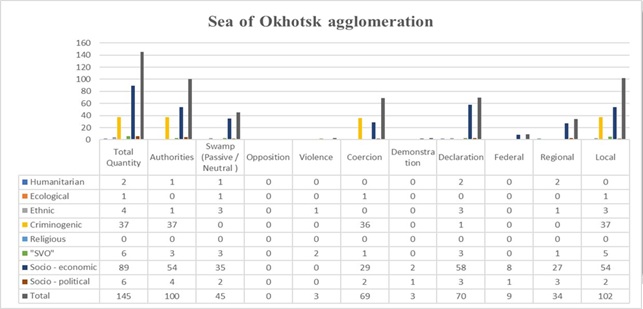
The winter period of 2025–2026 in Sakhalin Oblast and Kamchatka Krai is marked by a complex degradation of the socio-economic situation, worsening infrastructure problems, and an increase in local social conflicts. Events in the region indicate a gradual accumulation of crisis phenomena in the remote territories of the Russian Far East.
In the socio-economic sphere, the financial condition of the regions is deteriorating. Sakhalin Oblast has become one of the largest debtors among subjects of the Far Eastern Federal District, and some municipalities face difficulties in funding local budgets and paying salaries. In Kamchatka, public debt reached record levels, while utility tariffs, transport costs, and fuel prices are rising. Several settlements experienced power outages and reduced street lighting due to unpaid debts.
Infrastructure problems are exacerbated by natural and climatic factors. Snow collapses in Kamchatka disrupted transport connections, waste removal, and food deliveries. In some areas, emergency services had to rely on alternative transportation methods due to impassable roads.
In the social sphere, a shortage of medical personnel forces residents of certain settlements to seek medical assistance in other regions. At the same time, ethnic tensions and local conflicts related to migration processes have been observed.
The combination of economic hardship, infrastructure problems, and rising living costs has produced elevated social discontent. Although open protests remain limited, there is a gradual accumulation of social tension, which may intensify if the economic situation continues to deteriorate.
Conclusions
Across all regions, similar problems are evident: violations of fundamental citizen rights and freedoms, socio-economic and infrastructure challenges, and pervasive corruption, which authorities use to secure the loyalty of local elites.
The number of regions targeted by Ukrainian drones is steadily increasing, and more recently, missiles are striking with greater frequency. The war is literally knocking on Russians’ doors, yet they seem unwilling to acknowledge its presence in their own cities.
In various regions, people suffer from infrastructure failures and gaps in social services, while authorities tighten control and increasingly restrict even the most basic rights and freedoms.
Overall, Moscow’s demands to locally appointed officials are clear: provide more “cannon fodder” for the war against Ukraine. How local authorities meet these demands is their problem—along with managing dissatisfied populations. If they fail, repressive measures can be applied against them under the guise of “anti-corruption” efforts.
Authors:
Yuriy Syrotyuk
Yuriy Oliinyk
Ivan Yaniuk
Mykola Volhov
Armais Oganyan
Andriy Kovalov
Andriy Mykhailychenko
Yulia Dolia
Oleksiy Tkachenko
Ivan Hatsenko
Iryna Yevdochenko
Darya Shapoval
Translation: Oleksandr Chupak
Leave a Reply