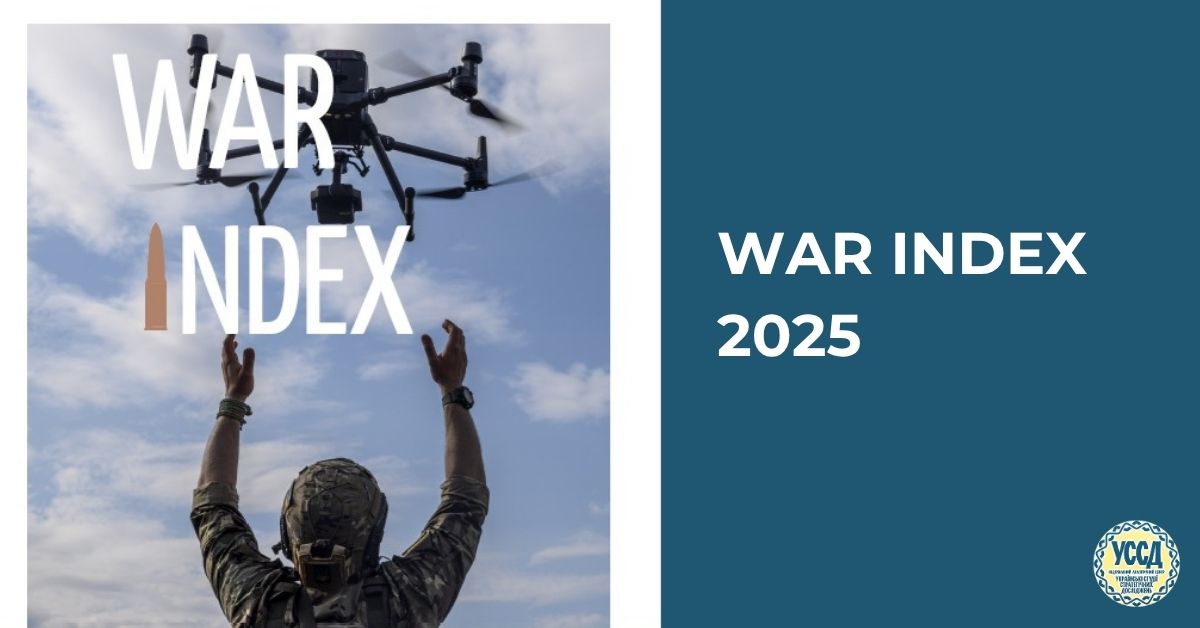
The Non-Governmental Analytical Center “Ukrainian Studies of Strategic Disquisitions” continues its annual project monitoring global military activity. We present to you the “War Index 2025.”
The War Index is a project providing annual monitoring of military conflicts for 2025. It ranks military-political conflicts and diplomatic clashes from the most intense and large-scale to the least visible but potentially dangerous. The methodology involves examining global conflicts actively manifesting during the research period through indicators that define their nature, progression, and significance for regional and global security. These are classified by tension level: from high-intensity “hot” wars to minimum-level confrontations.
Experts from the Non-Governmental Analytical Center “Ukrainian Studies of Strategic Disquisitions” propose a classification of military conflicts for analyzing global military activity:
Global wars (mostly involving multiple coalitions)
Regional wars
Local wars
Interstate wars (including low-intensity phases)
Wars between a state and a coalition
Foreign intervention
Civil wars (varying intensity, including external interference)
Border conflict (limited armed incident).
Local conflict.
Military coup.
Terrorism (or guerrilla action from a different perspective).
Internal political crisis – tension, political crisis (with the possibility of escalation and external intervention).
Diplomatic standoff – trade wars, diplomatic conflicts.
The methodology for determining the war index involves examining actively manifesting conflicts worldwide during the research period through a series of indicators delineating the conflict’s essence, progression, and significance for regional and global security, and classifying them by tension level, from the hottest to minimal confrontations.
In 2025, the primary global event remained the Russian-Ukrainian war, which, in terms of the intensity of technical assets utilized, has become one of the largest since the Korean War and the most significant conflict in Europe since 1945. The Palestinian-Israeli war continues to have serious consequences for the world and the Middle East; having begun in 2023 with a Hamas terrorist attack on Israel, it escalated into Israeli military operations in the Gaza Strip and Lebanon. This led to a series of reciprocal airstrikes between Iran and Israel, culminating in June 2025 with US involvement. In Syria, a new Sunni government is consolidating control, squeezing out the remnants of both pro-Iranian and pro-American forces.
Tensions are rising in the Pacific region. The situation around Taiwan remains traditionally difficult in the context of regular Chinese naval exercises. Of particular concern is the military threat demonstrated by the DPRK, which simultaneously acts as an effective ally of the RF in the war against Ukraine. Another epicenter of instability is Southern Asia, where the permanent conflict between India and Pakistan carries the threat of nuclear weapon use.
On the territories of less developed nations, long-standing conflicts persist, though a significant portion of them are decreasing in intensity within the framework of negotiation processes (e.g., in Ethiopia and the DR Congo). Tension is mounting in West Africa, where pro-Russian governments are unable to control their territories. A significant factor is also the diplomatic tension within NATO, caused by RF provocations and the diplomatic conflict surrounding Greenland.
Force remains the primary argument for resolving international disputes; its role is growing against the
backdrop of the destruction of international order by the world’s leading player—the USA. A characteristic feature has been the restoration of conventional warfare methods, involving frontal clashes of numerous armies.
Conversely, the importance of technical proficiency has become evident, primarily in the accuracy and speed of data transmission. The Russian-Ukrainian war is part of a global clash—a «silent Third World War» unfolding since 2011 across many theaters of military action. It is an undeclared war, involving all components of «fourthgeneration warfare,» breaking out through open military conflicts. Alongside the proxy confrontation between the USA and the PRC, regional leaders—Iran, Turkey, Saudi Arabia—are actively intervening in power competition. The influence of networked paramilitary groups is growing, as
is the emergence of the «quasi-state» tool. These quasistates fill the «dead zones» that form beyond the influence of national states, regional leaders, and as a result of superpower strategic confrontations. Private armies are engaged at full capacity. Direct military interventions, parallel with the broad use
of non-military instruments of pressure and coercion, reinforce the trend of using force as a means to achieve political goals.
Overall, the level of global tension continues to increase. This year, we have indexed 47 conflicts (both hot conflicts and those caused by diplomatic confrontation and internal political tension). Among them are: 8 wars, 2 border clashes, 16 local conflicts, 3 military coups or attempts, 11 manifestations of internal political crisis, 7 points of diplomatic confrontation.
Project Partners:
Global Ukraine Foundation.
Department of Regional Studies, Institute of International Relations of Taras Shevchenko National University of Kyiv.
Analytical Center for Balkan Studies.
The publication was prepared by:
Yuriy Syrotyuk,
Honorary President of the Non-Governmental Analytical Center “Ukrainian Studies of Strategic Disquisitions” (USSD), People‘s Deputy of Ukraine of the VII convocation, Chief Sergeant of the fire support company of the 5th Separate Assault Kyiv Brigade of the Armed Forces of Ukraine
Yuriy Oliynyk,
PhD in Political Science, Director of the Non-Governmental Analytical Center “Ukrainian Studies of Strategic Disquisitions” (USSD) serviceman of the Armed Forces of Ukraine
The following experts participated in the information collection:
Andriy Rudyk,
PhD in Social and Behavioral Sciences, officer of the Armed Forces of Ukraine
Marta Oliynyk-Dyomochko,
PhD in Political Science, Africanist researcher, Global Ukraine Foundation
Bohdan Cherkas,
PhD in Political Science, Assistant at the Department of Regional Studies of the Institute of International Relations of Taras Shevchenko National University of Kyiv
Kateryna Shymkevych,
PhD in Historical Sciences, expert at the Center for Balkan Studies
Oleksandr Chupak,
Head of Economic Programs at the Non-Governmental Analytical Center “Ukrainian Studies of Strategic Disquisitions” (USSD)
Oleksiy Tkachenko,
expert at the Non-Governmental Analytical Center “Ukrainian Studies of Strategic Disquisitions” (USSD), officer of the Armed Forces of Ukraine
Anatoliy Demeshchuk,
PhD in Historical Sciences, expert at the Center for Balkan Studies
Oleksandr Koptyev,
expert at the Center for Balkan Studies
Yaroslav Kurtov,
expert at the Center for Balkan Studies
Hlib Mykhailyk,
expert at the Center for Balkan Studies
Layout: Mykhailo Kubliy
Contacts: Tel.: +38(067) 605-35-05 E-mail: nac.ussd@gmail.com ussd.org.ua
The publication includes maps and illustrations purchased on depositphotos.com and from open sources.
Leave a Reply