
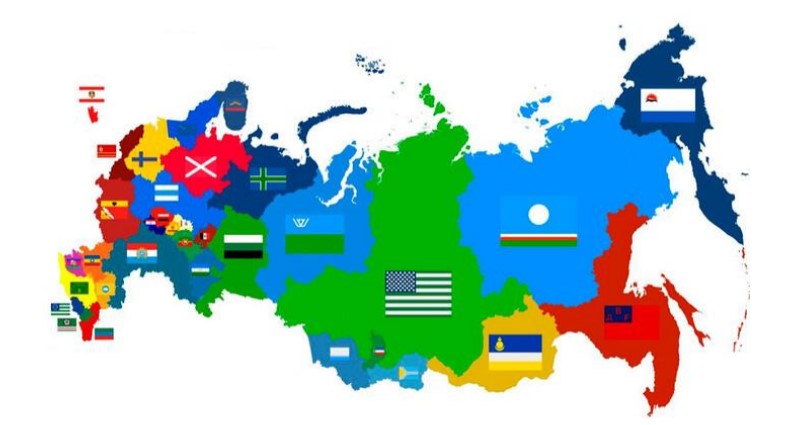
Monitoring Summer 2026
The Non-Governmental Center for Political Analysis “Ukrainian Studies of Strategic Disquisitions” continues its long-term project of Monitoring Regional Processes in the RF.
The goal of the study is to capture and define the dynamics of conflict-generating and disintegrative factors that will contribute to the deconstruction of the Russian Federation and its disappearance as a geopolitical reality.
The object of the monitoring is the information field of the Russian Federation; the most popular news per quarter across various regions of Russia is analyzed, providing a more or less clear picture of internal processes occurring within the aggressor state and allowing for the monitoring of conflict-generating regional processes.
Monitoring of Regional Processes in the RF: Summer 2026
Throughout the summer, regions of the RF continued to suffer from Ukrainian “long-range sanctions,” an extremely decayed and ineffective imperial management system, and all the flaws of outdated infrastructure. While the general population continues to “endure” (“terpet”), the authorities are increasingly tightening the screws, accelerating the flywheel of repressions against dissenters.
CENTRAL-WESTERN REGION
Moscow Region
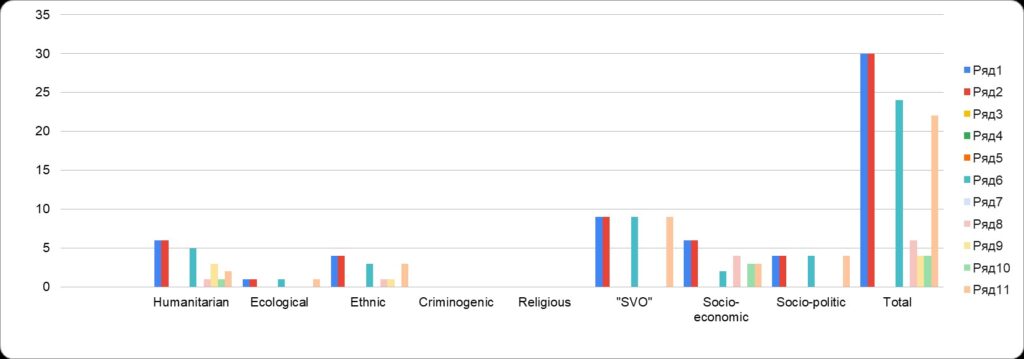
In the summer of 2026, the Moscow Region faced a simultaneous worsening of economic, security, and political problems, a significant portion of which is directly or indirectly tied to the war. The most noticeable socio-economic factor was the fuel crisis: rising prices combined with sales restrictions, a reduction in the number of gas stations, and periodic shortages. The authorities’ reaction was aimed mainly at administrative containment of the problem and control of information about it, rather than eliminating its root causes.
The second defining process was the further narrowing of the digital space. Mobile internet restrictions, VPN issues, blocking of specific information distribution channels, and the gradual abandonment of Western services are shaping an increasingly isolated information environment. Simultaneously, digital technologies are being used more actively for state control: the integration of university databases with military enlistment offices demonstrates the expansion of mobilization infrastructure directly into the educational system.
The war is impacting the daily life of the capital and the region ever more noticeably. Regular UAV threats lead to air traffic restrictions, while dissatisfaction over the lack of a sufficient number of shelters and warning systems points to a mismatch between the scale of the security threat and the readiness of civilian infrastructure. In parallel, a new layer of the managerial elite is forming from participants in the aggressive war against Ukraine, indicating the gradual institutionalization of the war factor in domestic policy.
The tightening of control is also traceable in the migration and political spheres. Mass checks of migrants, expanded grounds for deportation, and harsher restrictions on their civic activity are complemented by repressive measures against the political opposition. At the same time, signs of dissatisfaction are emerging not only among opposition activists, but already within the formally loyal political environment. Overall, the summer demonstrated the Moscow Region’s transition to a model where economic and security difficulties are increasingly offset by expanding administrative, digital, and law-enforcement control.
Bryansk Region
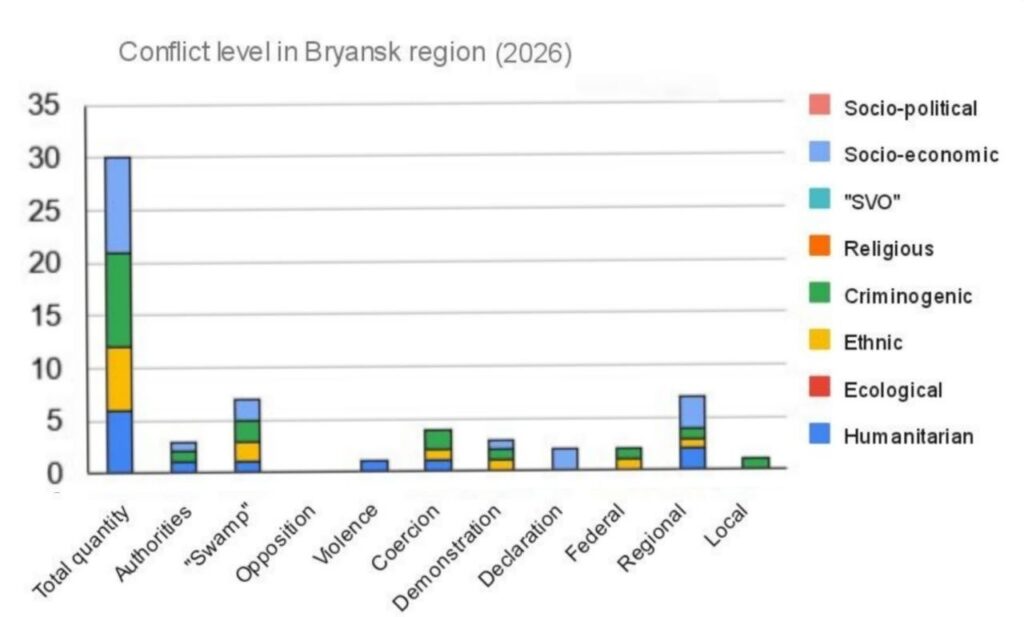
In the summer of 2026, the situation in the Bryansk region was characterized primarily by the tightening of administrative control against the backdrop of a gradual deterioration of certain socio-economic indicators. Unlike the spring period, there are no signs of large-scale crisis dynamics in the provided selection, but there is a traceable accumulation of local problems related to the financial state of the population, social behavior, and the expansion of state surveillance.
The most important economic indicator was the 10.8% increase in overdue mortgage debt since the beginning of the year. Combined with the stagnation of the secondary housing market, this indicates a decline in household solvency. An additional indicator of the state of the social sphere is the set minimum wage for a teacher at 22.8 thousand rubles, which demonstrates the limited financial capabilities of public sector employees. At the same time, an almost threefold increase in sober center (vytverzenyk) visitors can be viewed as an indirect indicator of distress, although based on these data alone, linking it directly to the economic situation is premature.
A noticeable trend was the expansion of control and punishment practices. Curfew restrictions for minors, automated fines for entrepreneurs, installation of cameras against illegal dumping, transport raids, and a temporary ban on alcohol sales demonstrate the predominantly administrative nature of the authorities’ reaction to daily life and social problems.
The security/enforcement component manifests especially clearly in migration policy. Large-scale checks, deportations, and entry bans are complemented by controlling the military registration of new Russian citizens. Thus, migration control is integrating ever more tightly with the state’s mobilization needs.
Overall, the current situation points not so much to a sharp deterioration in the Bryansk region’s position, but rather to a combination of gradual financial pressure on the population with the tightening of regulatory and enforcement control. Meanwhile, practically no open manifestations of significant socio-political dissatisfaction were recorded.
Kursk Region
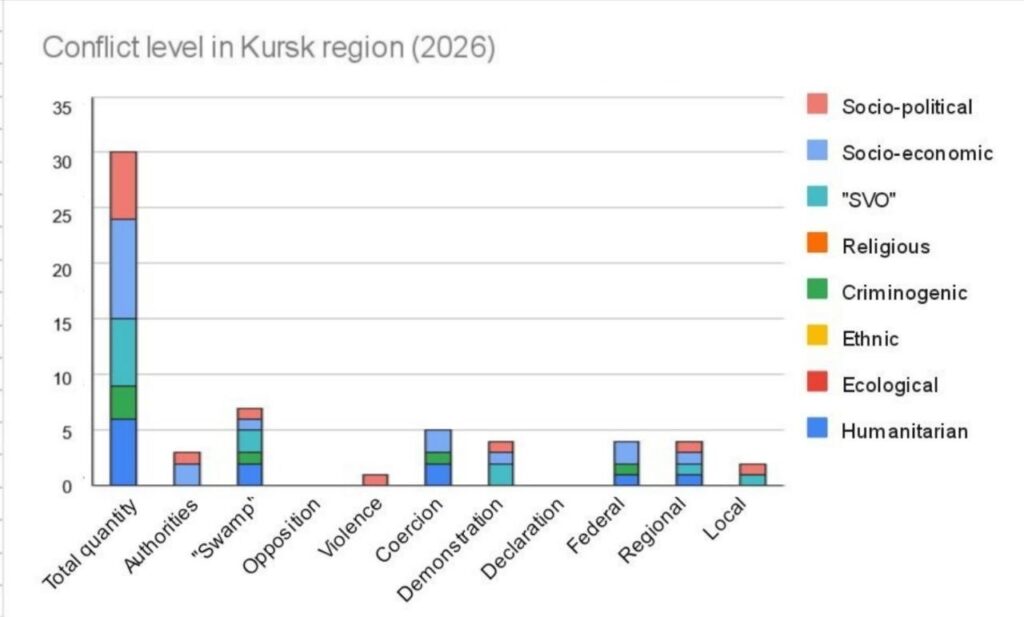
In the summer of 2026, the situation in the Kursk region was defined primarily by the consequences of the region’s border character and the gradual deterioration of socio-economic conditions. The most noticeable everyday problem was the instability of the fuel market. Restricting gasoline sales to 20 liters and banning sales into canisters, even with the formal availability of fuel at gas stations, caused lines and panic buying. This shows that administrative restrictions themselves are capable of provoking deficit expectations and heightening public anxiety.
At the same time, housing affordability is worsening: the time required for an average family to save for a two-room apartment increased over the year from 4.6 to 5.5 years. This is the most distinct socio-economic indicator, pointing to a growing gap between population incomes and real estate costs.
Corruption in regional governance remains a separate systemic problem. A severe sentence for a former governor and an investigation into a former deputy governor, specifically regarding the potential embezzlement of funds during the construction of defensive lines, demonstrate the scale of problems in the governance system. What makes this particularly conflict-generating is that it involves resources intended for the defense of a border region.
Meanwhile, the war is integrating deeper into the daily urban environment. Civilian deaths from UAV attacks, the appearance of memorial murals, and even the artistic decoration of concrete shelters attest to the gradual normalization of the war threat as a permanent component of life. A long-term ban on crypto mining in part of the region also demonstrates the prioritization of security and energy needs over standard economic activity.
Thus, the Kursk region is characterized by society’s gradual adaptation to a virtually constant border-war regime. In contrast to a sharp crisis scenario, a cumulative effect is observed here: war risks combine with deteriorating housing affordability, fuel instability, and high-profile corruption cases, gradually altering the population’s usual living conditions.
Belgorod Region
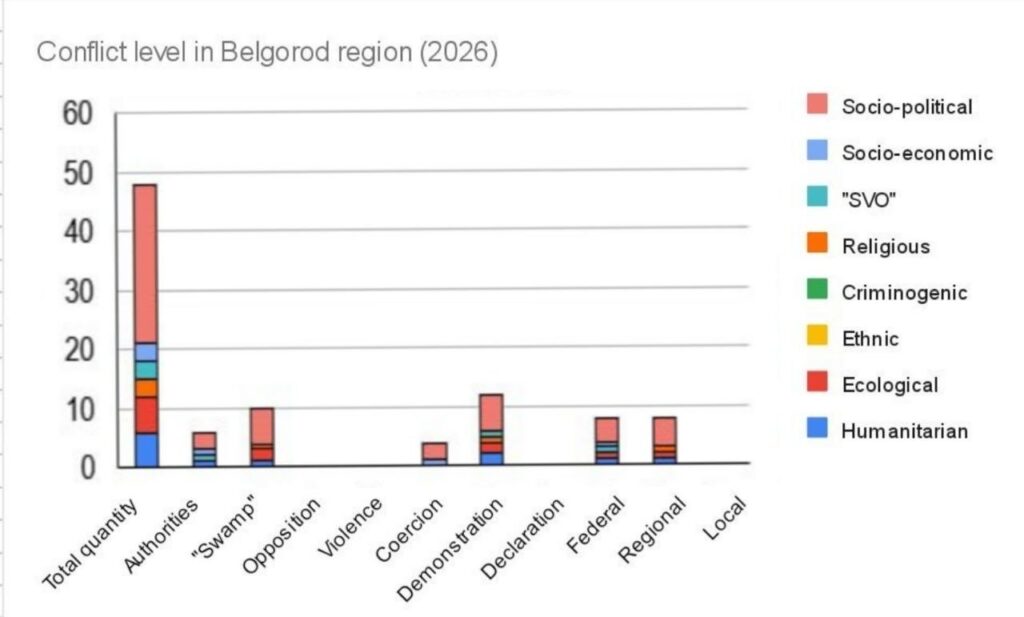
In the summer of 2026, the Belgorod region continued to adapt to conditions of prolonged border instability. The most noticeable problems were fuel and energy difficulties, the need to back up critical infrastructure, and the gradual penetration of war-related restrictions into everyday life. At the same time, the provided material does not indicate a general socio-economic collapse of the region.
The fuel crisis became the most tangible issue for the population. In border Shebekino, where gasoline is also necessary to run generators, the price of AI-92 reached almost 100 rubles, and AI-95 disappeared from sale. The persistence of problems through the end of August and the involvement of Belarusian supplies indicate that the deficit acquired a broader character and was not quickly resolved. Simultaneously, the region received significant federal funding for generators and backup power sources, pointing to preparation for potential long-term disruptions in the energy system’s operation.
The war factor increasingly defines the organization of civilian space. A nighttime ban on motorcycle traffic and the creation of backup power capacities supplement the already established system of restrictions in the border region. A significant quantity of issued rehabilitation equipment, particularly prostheses and wheelchairs, demonstrates a noticeable burden on the relevant social infrastructure; however, the provided data do not allow for determining what portion of this demand is directly linked to the war.
Ecology and state governance remain separate problematic areas. Mass fish die-offs in the Siverskyi Donets and the shallowing of the Belgorod reservoir point to a worsening state of aquatic ecosystems, though the causes of these phenomena cannot be unambiguously established from the provided data. The resignation of the Minister of Construction against the backdrop of an investigation into potential embezzlement during the construction of defensive fortifications continues the trend of corruption scandals surrounding resources allocated for the region’s defense.
Overall, in the summer, the Belgorod region functioned increasingly as a region under a permanent war-emergency regime, where a significant portion of resources and managerial decisions are directed toward maintaining basic resilience — power supply, fuel, and security. This speaks to a gradual normalization of crisis conditions rather than overcoming them.
CAUCASUS
Dagestan
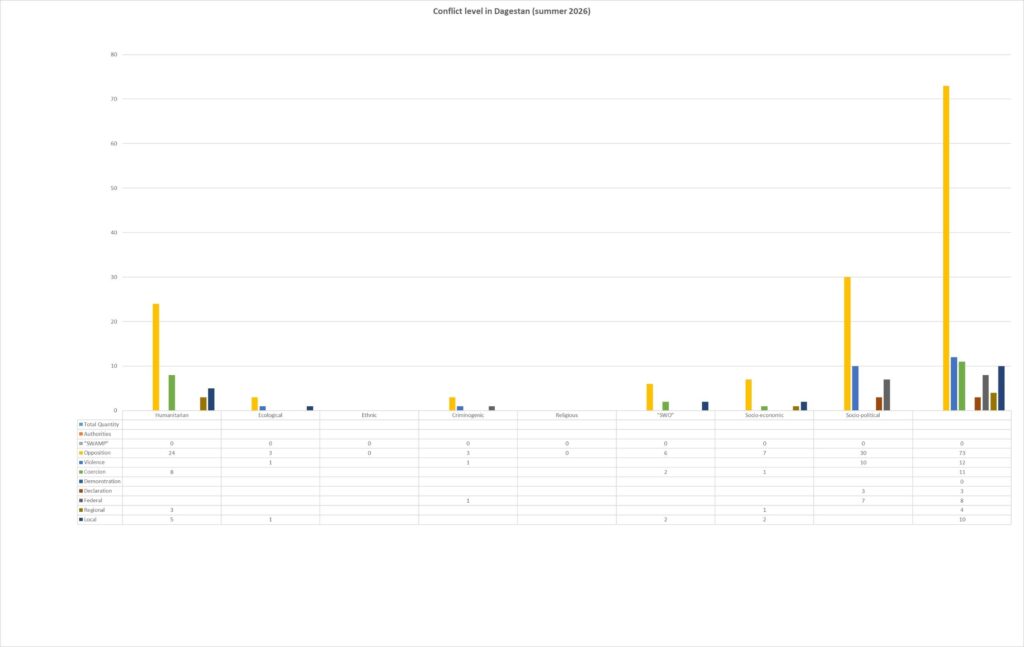
During the studied period, the region faced natural disasters and an extremely ineffective response from the authorities. Over the summer, several floods occurred in Dagestan, damaging transport infrastructure and leaving dozens of settlements cut off from the outside world.
At the same time, confrontation is intensifying within the government itself, evidently against the backdrop of diminishing resources that various clans are attempting to usurp under their control. Under such circumstances, previously untouchable deputies and heads of state and semi-state companies are becoming victims of persecution by security forces. The most striking examples: former General Director of “Kaspenergosbyt” Zamir Abduragimov and the brother of a State Duma deputy from Dagestan and Deputy Head of “Dagnoft,” Akhmedpasha Umakhanov.
All of this is taking place against the backdrop of a fuel shortage caused by long-range strikes by the Armed Forces of Ukraine. Additionally, due to outdated infrastructure, the region experiences power supply issues that trigger mass public protests, which the leaders of the republic themselves are forced to stop in person.
In order to keep the situation under control, the authorities are tightening repressions against the free press and against any actions directed against the regime. Imprisonment on terrorism charges can result from provocative videos or actions that under normal circumstances would be classified as “hooliganism”.
CENTRAL-EASTERN REGION
Orenburg Region
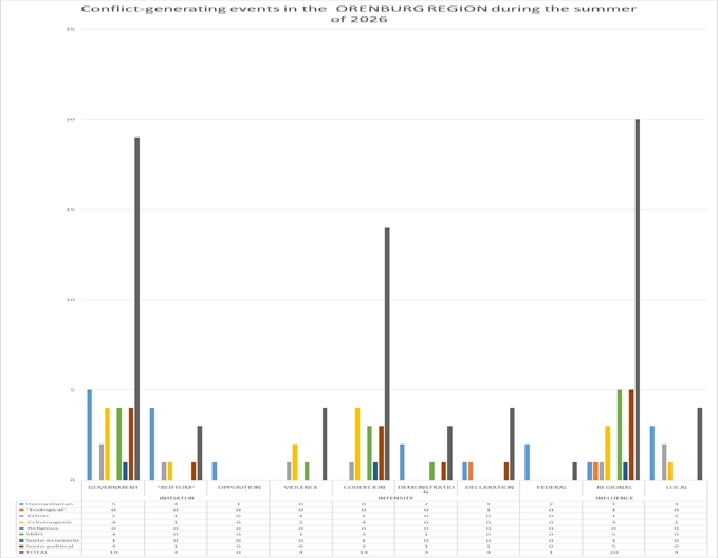
In the summer, the region felt the growing activity of Ukrainian UAVs. Targets for them this time, besides the local oil refinery, included the gas processing plant and, more importantly, the helium plant in Orenburg. There was also a single strike on an Ozon warehouse. The number of air raid alerts increased. Because of this, the authorities imposed restrictions on broadcasting from street cameras. Arrests for attempting to damage cell towers featured in the news again, as well as the preparation of sabotages against critical infrastructure facilities (specifically against military freight trains), and posts online that did not align with the Kremlin’s historical narratives. Furthermore, cases of large-scale fraud involving payments to “SVO” veterans were recorded (specifically, OCGs collaborating with representatives of local authorities), along with administrative pressure on conscripts to force them to sign contracts.
Manifestations of the fuel crisis, common to regions facing similar problems, were felt in the oblast (lines at gas stations, limits on per-person sales, disruptions with specific types of fuel, price gouging, including in online environments).
Cases of corruption in road repairs and oil extraction were recorded. Meanwhile, the oblast budget is formed in such a way that there is not enough money even for certain basic infrastructure needs (for instance, in one village of the Orenburg district, the authorities suggested that residents chip in their own money to repair a section of road that hadn’t seen repairs in over 10 years; in one district of the regional center, the lack of a sufficient number of children’s education facilities caught the attention of the Investigative Committee of the RF).
As part of the preparations for elections to the Legislative Assembly of the region, one can note the return to politics of ex-governor Salmin, who had previously served a year in “BARS,” and the inclusion on electoral lists of VDV officer Mussagaleyev, who was involved in crimes in the Kyiv region (both are running from “United Russia”). On the flip side, the registration of a number of self-nominated candidates (even from the CPRF) was “scrapped”. In this way, the authorities are trying to safeguard themselves as much as possible against any potential pockets of dissent (this is done thanks to a complex signature collection procedure for self-nominated candidates that technically appears almost insurmountable).
Bashkortostan
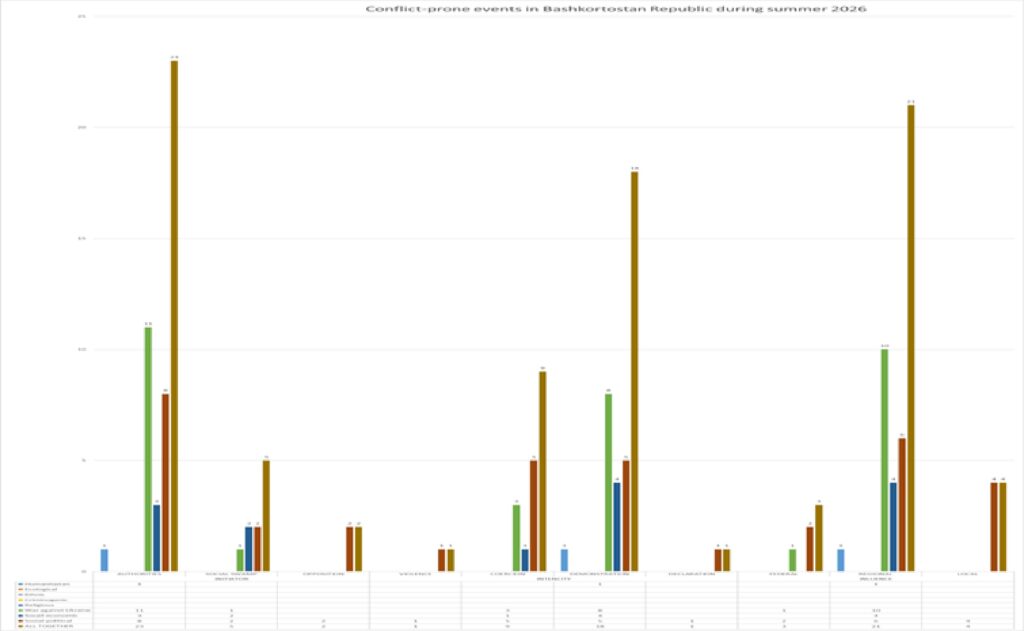
In Bashkortostan, the authorities continue to incite residents to join the war against Ukraine. Thus, starting June 16, 2026, the Head of the Republic, Khabirov, voiced the goal of recruiting at least 300 people into the “BARS for the RF” structure in Bashkortostan. It is being formed by the RF alongside mobile fire groups to counter UAVs on the territory of Bashkortostan. However, to join, one must sign a contract with the Armed Forces of the RF, according to which they can be deployed anywhere outside Bashkortostan. In June 2026, BARS of Bashkortostan already began countering UAVs, according to official reports. On August 4, Khabirov announced the formation of the Gareyev Unmanned Systems Battalion in Bashkortostan. Khabirov also extended the 1 million ruble payout for a first contract until August 31. Operating under Ufa University of Science and Technology is the organization “Motors of the Future,” which openly assembles UAVs and involves schoolchildren in the process. Starting August 21, veterans of the war against Ukraine have been systematically conducting propaganda lessons in Bashkortostan schools. As of June 9, 4,000 such veterans had returned to Bashkortostan, a third of them disabled, according to data from Bashkortostan Prime Minister Nazarov.
However, citizens of the RF in Bashkortostan, as everywhere else, are having to pay more for the war against Ukrainians. Over the summer of 2026, there were repeated strikes, including on refinery facilities and Ozon warehouses in Ufa, a petrochemical plant in Salavat, 2 oil pumping stations, and Wildberries warehouses on the Republic’s territory. Nevertheless, despite the example of neighboring regions, air raid sirens are not turned on in Bashkortostan—as Khabirov stated, so that the population buys fewer antidepressants. At the same time, the budget deficit in Bashkortostan is such that local authorities are selling “Bashneft” to the RF center and have officially acknowledged collecting taxes from businesses in advance from 2025.
Due to strikes on RF fuel industry facilities, a fuel crisis has also engulfed Bashkortostan. The authorities (Khabirov and his inner circle, Acting Mayor of Ufa Sharipov, and most district heads) are responding to it with trade restrictions and pressure. Namely, fuel sales limits and bans on sales into canisters; to enforce punishment for the latter, vigilantes (druzhynnyky) are deployed at Ufa gas stations, along with cynical accusations blaming the population for the fuel deficit due to panic buying and because they walk and ride bicycles too little. Despite not declaring air raid warnings, the authorities have mandated the closure of some gas stations during alerts. Such actions benefit Ukraine, as they drive the population into a planned, rotten pit where it will perish. The behavior of the head of the Abzelilovsky district, delivering reserve fuel to villages without gas stations, is a constructive rarity, fortunately.
The population of Bashkortostan periodically explodes with dissatisfaction over the critical situation. Farmers are outraged over the ban on buying fuel reserves, and fights break out in gas station lines. On July 3, 2026, a 5-person rally in defense of the Bashkir language took place in Ufa with placards reading “Resignation for the Minister of Education of Bashkortostan,” “Restore national education in Bashkortostan schools,” and “In a federal state, education cannot be unified.” The organizer of the action, Irek Agishev—a pensioner and leader of the Bashkir center for promoting public education “Aktamyr”—was arrested, and rally participant Gazizov was also fined. In 2025–2026, Agishev also took part in opposing the naming of an Ufa street after Zhirinovsky. The mayor of Ufa, Ratmir Mavliyev, who was arrested for corruption, is playing his own game and secured reinstatement to his post through the Supreme Court of Bashkortostan. Khabirov refused to cooperate with the reinstated Mavliyev. The authorities are also responding with other repressions: arresting opposition candidate for Ufa mayor Denis Malyshev allegedly for discrediting the Russian Armed Forces, fining a pensioner for a donation to the “Anti-Corruption Foundation,” and tracking down and punishing provocateurs ahead of the State Duma “elections” on September 18, 2026. The RF authorities fully control the correspondence of the population—including in Bashkortostan—in the “Max” messenger app and issue fines for non-standard behavior there. Furthermore, RF authorities officially acknowledged that they will not restore the monument to the fighter against the Muscovites—Bashkir national hero Yulaev—citing its catastrophic condition. However, the level of state repression in Bashkortostan has decreased, while activity against the catastrophic situation caused by the war with Ukraine is growing.
Udmurtia
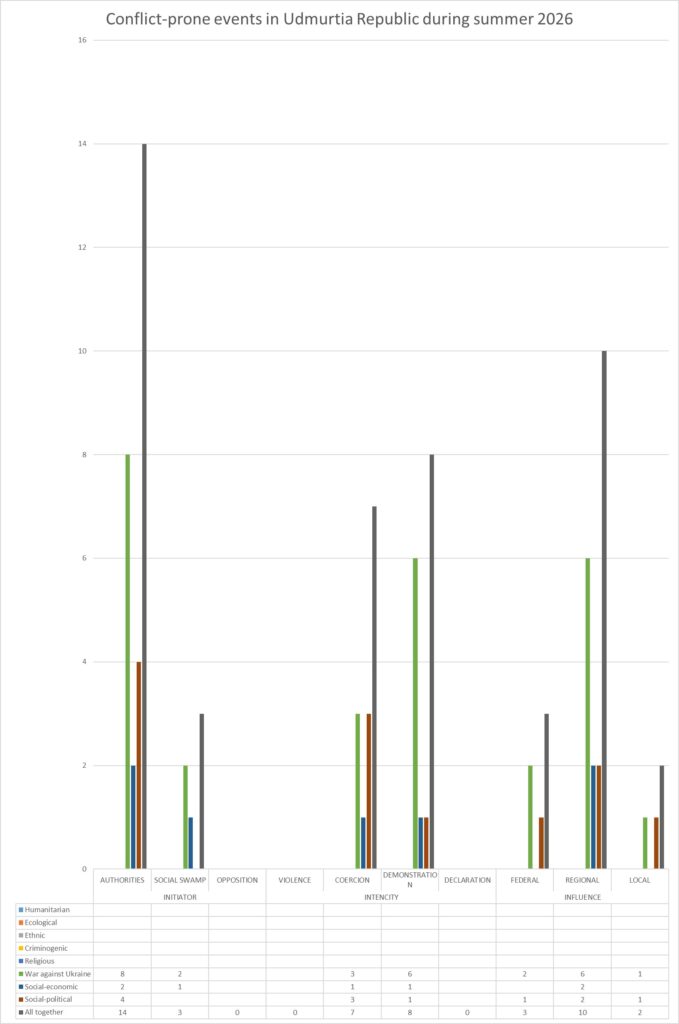
The Republic of Udmurtia, which usually demonstrated stagnant calm in the RF, churned with distrust toward the latter’s authorities. The reason is the consequences of the war against Ukraine and belt-tightening by the RF government. Specifically, repeated strikes on facilities in Udmurtia—on oil refineries and “Wildberries” warehouses in Sarapul, and the “Prioritet” fuel plant in the village of Borok. Added to this is official inaction against the background background, such as the authorities of Izhevsk and Votkinsk failing to publish the list of shelters they promised back in 2025. Over the summer, a number of cases were established in Udmurtia involving the coercion of citizens into signing contracts with the Russian Armed Forces through beatings and deception of people with intellectual disabilities—similar to cases in 4 neighboring regions. Udmurtia joined the wave of forcing “lessons of courage” by veterans of the war against Ukraine onto children in RF schools.
Since June 2026, Udmurtia has also been engulfed by a fuel crisis, accompanied by sales restrictions on fuel. Prime Minister of Udmurtia Roman Efimov urged residents to refuel only when necessary, emphasized the ban on filling containers, and dispatched vigilantes to gas stations to punish violators. He was supported by the Head of the Republic, Aleksandr Brechalov, who accused the population of hiding fuel in garages and canisters. However, flamboyant statements no longer helped Brechalov. Having been in office since 2017 and having lost control, Brechalov was dismissed by Putin on July 29, 2026. Appointed as acting head from the center was Olga Abramova—formerly Deputy Chair of the Government of Udmurtia, currently Assistant to the Minister of Agriculture of the RF.
The RF authorities respond with repression to all manifestations of population disobedience in Udmurtia. An Izhevsk city council deputy was sentenced to 2 years probation for a 2024 Telegram comment against corruption; CPRF State Duma candidate Bondarenko was arrested for alleged “propaganda of Nazism and extremism,” as was the leader of a regional candidate group including Udmurtia (likely for criticizing the RF authorities’ ban on the “Yabloko” party participating in State Duma elections). Demonstrative handouts from the authorities are also present, such as the Udmurtia ombudsman helping a conscript who hadn’t carefully read the terms break a contract with the RF Armed Forces—one out of dozens of such cases. However, all of this is helping the RF authorities less and less to maintain control in Udmurtia.
Tatarstan
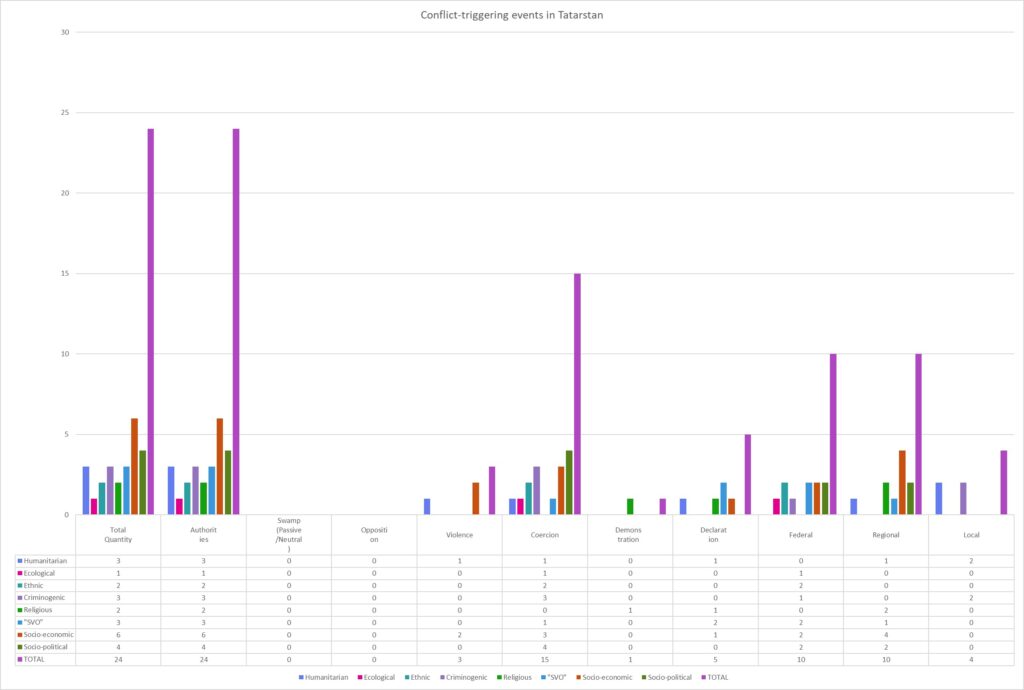
In the summer of 2026, Tatarstan was characterized by a simultaneous worsening of economic, security, and political problems, with the war increasingly defining internal processes in the republic. Most tangible was the deterioration of the economic situation: growing budget deficits combined with the unprofitability of a significant share of enterprises and massive war-related expenses. The situation surrounding KAMAZ is particularly telling: the enterprise’s financial difficulties and the increased participation of federal structures in its capital create conditions for the further erosion of Tatarstan’s economic control over one of its key industrial assets.
A direct consequence of the war was the growing vulnerability of industrial and energy infrastructure. Damage to oil refining facilities caused fuel shortages, sales limits, and subsequent price increases. Simultaneously, enterprises are forced to self-finance anti-drone protection, passing additional costs onto product prices. UAV attacks and human casualties demonstrated that Tatarstan’s distance from the front line no longer guarantees its former level of security.
The social consequences of the war are also accumulating. Heavy losses among the mobilized hit certain rural communities especially hard, reducing the working-age male population. Against this backdrop, disruptions in critical medicines and the redirection of patients to neighboring regions demonstrate the overstraining of civilian social infrastructure.
In parallel, political and informational centralization continues. Reduced Tatarstan representation in the federal parliament, the elimination of opposition candidates, the persecution of uncontrolled activists, and the expansion of property sanctions against disloyal citizens are narrowing the space for political self-organization. Prolonged mobile internet outages and technological suppression of VPNs further restrict opportunities for independent communication.
A distinct trend is the further weakening of specific Tatar cultural and political agency through the centralization of language and national policy, alongside deteriorating conditions for Tatar-language media. Combined, this forms a model of dual pressure for Tatarstan: economic and human resources are increasingly funneled toward the needs of the federal center and the war, while the republic’s own economic, social, and cultural capabilities are shrinking. This creates fertile ground for the further accumulation of discontent.
Chelyabinsk Region
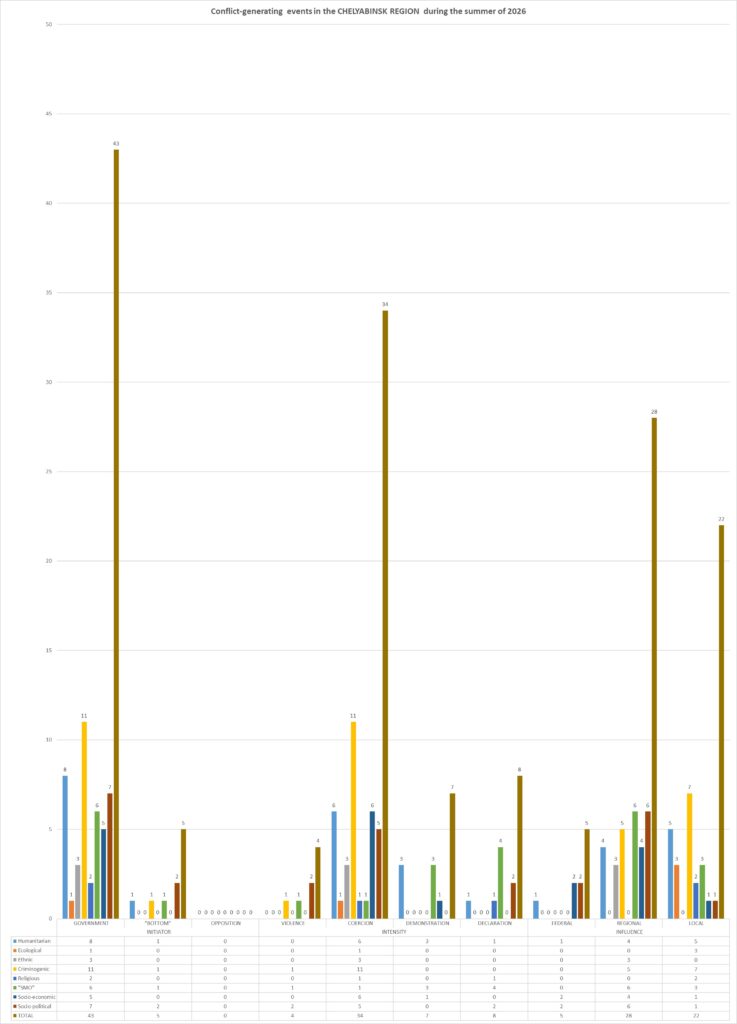
Summer was marked for the region by a further increase in the number of air raid alerts; however, there were no reports of strikes on major facilities, only UAV transit. Most likely, this is because during the specified period, the Ukrainian side was more interested in energy infrastructure and Wildberries warehouses in neighboring regions. Nevertheless, the FSB reported preventing a drone sabotage on the “Shagol” airfield (following the pattern of Operation “Web”). The leadership of the region is increasingly forced to adapt to these realities, which manifests in building up the warning and shelter system, mass implementation of alert action protocols for municipal staff, and accelerated preparations for winter.
Attacks on oil refineries in neighboring Bashkortostan, Tatarstan, Orenburg, Perm, and Tyumen regions caused a fuel crisis in the region (sales limits, queues, abuses in fuel circulation, price hikes), forcing authorities to adopt additional control measures. The burning of nearby Wildberries and Ozon warehouses by Ukrainian UAVs dealt tangible losses to Chelyabinsk entrepreneurs.
Oblast Governor Teksler strives to showcase the region’s active participation in the “SVO,” declaring the goal of making the region a flagship of robotics in the country, actively recruiting new soldiers (even abolishing mandatory regional registration for this purpose), supporting previously initiated incentive programs for veterans, and attempting to direct tourist flows to occupied territories via new transport routes (trains to Crimea, flights to Abkhazia). The tank school has been restored. One military enterprise was even decorated by Medvedev, and one university landed on the US sanction list.
In addition to usual local arrests for “extremism,” “justification of Nazism,” etc., regional authorities are attempting to deploy AI technologies to scale up monitoring of the aforementioned phenomena. Meanwhile, as part of preparations for the State Duma elections, potential self-nominated candidates (even from “their own” CPRF) were almost completely “cleared out.”
In the sphere of corruption, scandals primarily connected to Chelyabinsk’s municipal infrastructure (specifically “Sberbank”) stand out, alongside the arrest of a former high-ranking official from the regional prosecutor’s office.
FAR EAST
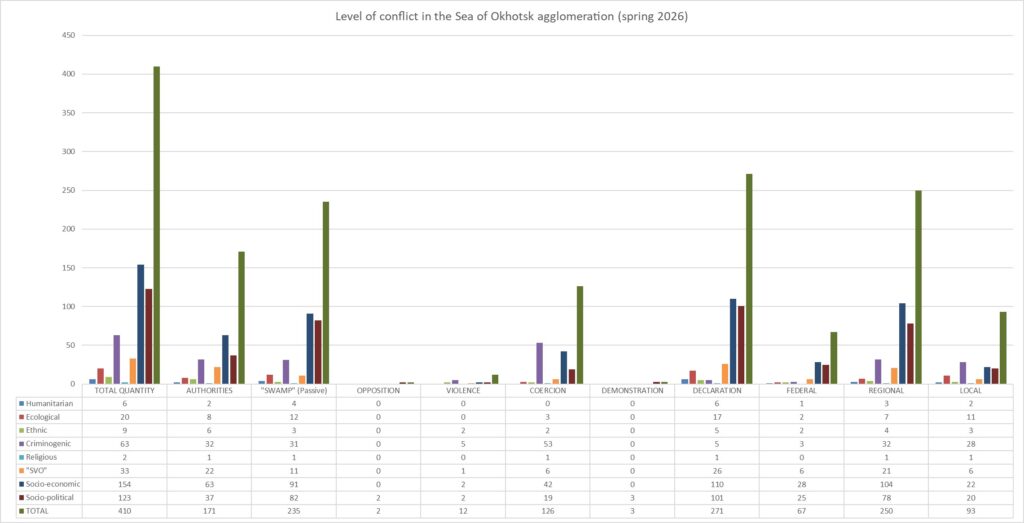
In the summer of 2026, the Sakhalin Region and Kamchatka Krai demonstrated a further accumulation of socio-economic, infrastructural, and ecological problems. According to monitoring, 410 conflict-generating events were recorded, dominated by socio-economic and socio-political issues. At the same time, most manifestations of discontent remained declarative, though the overall level of tension rose significantly.
The socio-economic situation was the most acute factor. On Sakhalin, real opportunities for the population are shrinking against high prices, fuel shortages, a drop in residential construction, business closures, and transport connection problems. On Kamchatka, these processes manifest even more sharply: fuel prices crossed 100 rubles per liter, wage and mortgage debts are growing, and infrastructure accidents are capable of virtually paralyzing cashless payments and communications.
Environmental degradation is becoming a distinct systemic risk. On Sakhalin, oil product pollution combines with a sharp decline in fish resources, while on Kamchatka, large-scale fires and a failed salmon fishing season demonstrate state structures’ inadequate capacity to respond to ecological crises. This is especially dangerous given both regions’ dependence on natural resources and the fishing industry.
In parallel, the militarization of public life is deepening. Military themes are penetrating education, social policy, and regional governance; however, propaganda-driven heroization of war participants increasingly contrasts with negative or ironic reactions from the population. On Kamchatka, this gap is particularly noticeable in reactions to military and political information campaigns.
A common trend for both regions is the widening gap between the official picture of “development” and the daily experience of the population. Pre-election PR, censorship of criticism, and manual fixes for isolated problems no longer offset the accumulation of infrastructural and social hardships. At the same time, discontent for now manifests mainly through criticism, sarcasm, and passive distancing from authorities rather than through organized protest activity.
CONCLUSION
In the summer of 2026, long-range strikes against the rear of the Russian Federation definitively became systemic. Certain regions of the RF shifted to a wartime existence mode. Meanwhile, Ukrainian forces expanded their strike target set beyond strictly military-use facilities like defense plants to dual-use product manufacturers. In addition to oil refineries and other energy facilities serving the Russian military, attacks now target logistics hubs, the largest being warehouses of Ozon and Wildberries.
The Russian authorities are desperately trying to force their population into the military by enticing them with economic benefits; however, money is becoming scarcer and scarcer, and the scent of full-scale mobilization is increasingly in the air.
Under these circumstances, enforcement agencies are tightening the screws ever more actively. The number of persecutions of opposition activists and journalists is growing. The room for maneuver is shrinking, while Russian investigative and judicial bodies interpret an increasing number of public order violations as terrorism.
Authors:
Yurii Syrotiuk
Yurii Oliinyk
Ivan Yaniuk
Armais Ohanyan
Andrii Kovaliov
Andrii Mykhailichenko
Oleksii Tkachenko
Ivan Hatsenko
Iryna Yevdochenko
Leave a Reply